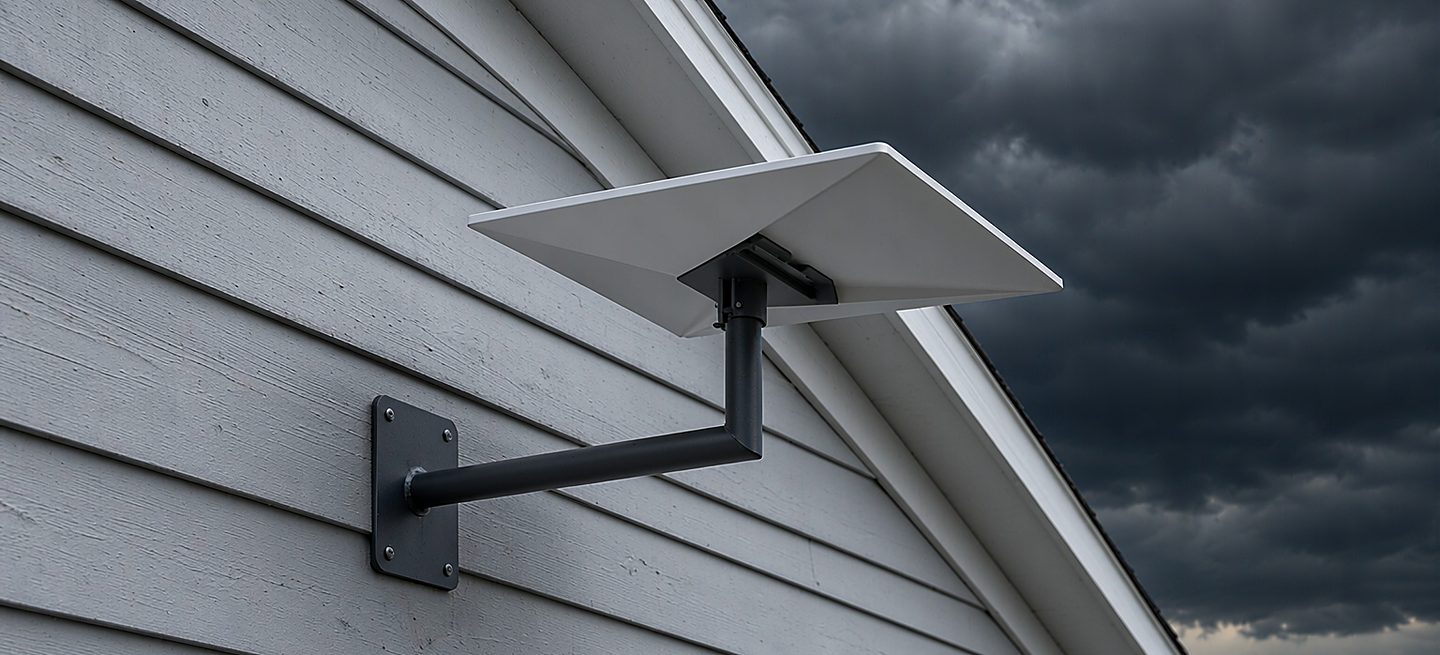
Short version: a Starlink dish on a metal mast is an outdoor antenna installation, and in the US that puts it under Article 810 of the National Electrical Code - the mast, the lead-in and the bonding conductor, not just the dish. The bracket you buy is the part that puts metal in the air, and a bracket bolted to a wall bonds nothing by itself. Nothing you install will survive a direct strike; what you can control is where the current goes and whether your house is on the path. This page is about what applies and what to ask. It is not wiring instructions, and the conductor that matters ends at your service grounding electrode - which is an electrician's signature, not a blog post's.
Almost every Starlink install guide stops at "you're online". The app does not mention grounding, the box does not mention grounding, and the dish works fine without anyone thinking about it - right up until a storm pushes current down a cable that had nowhere to go. That silence is not permission. It is the same silence that surrounds TV aerials, and Article 810 exists precisely because that silence used to be the norm.
What Article 810 actually covers
Three things, and they are three separate jobs that people mash into one word. Read them as a checklist of what has to exist, not as a plan you execute yourself.
| Code item | What it covers | What that means here |
|---|---|---|
| 810.15 - mast | The metal mast of an outdoor antenna has to be bonded to the building's grounding electrode system | Your bracket and mast are the metal in the air. This is the item a mount owner actually controls |
| 810.20 - lead-in | Each lead-in conductor needs a listed antenna discharge unit, near the point of entry, away from combustible material | Starlink's lead-in is a proprietary power-and-data cable, not coax - so the classic screw-on discharge unit does not simply bolt on |
| 810.21 - bonding conductor | Material, minimum size, route, protection and where it terminates | This is where the internet's wire-gauge arguments come from, and where most of them are wrong |
Two footnotes worth knowing before you talk to anyone. First, 810.21 requires the bonding conductor to run "in as straight a line as practicable" - lightning does not like corners, and a conductor that loops around a porch to reach the panel is a worse conductor than its gauge suggests. Second, the termination point in a modern house is the intersystem bonding termination near the service equipment, which is the bar telephone and cable installers are supposed to use. If your house does not have one, the conductor goes to the grounding electrode system instead. That is a decision for someone standing at your panel, not for a page.
Ten gauge, not six - and why the internet says six
Search this topic and you will find confident guides insisting the code minimum is 6 AWG copper. It is not. The bonding conductor for the mast and the discharge unit is 10 AWG copper minimum, or 17 AWG copper-clad steel or bronze. The six-gauge number comes from a different sentence: if you drive a separate ground rod to serve the antenna system, that rod has to be bonded back to the building's power grounding electrode with a conductor of at least 6 AWG. Two different conductors, two different jobs, and a lot of articles quietly merge them.
This matters for a practical reason. On a Starlink install the run from the mast to the service is often long and awkward - up a gable, across a soffit, down a wall. Somebody who thinks the code demands 6 AWG for the whole run will decide the job is impossible or expensive and skip it. Somebody who knows it is 10 AWG minimum, run as straight as practical, may find the job is a morning's work. Heavier is never wrong; believing it is mandatory is how installs die in the planning stage.
Why the mount is the part that matters
Our wall bracket is steel, and so is the mast it holds. That is normal and it is fine - but it means the assembly is a continuous piece of metal standing above your roofline, and the questions move from "is this mount strong enough" to "what is this metal connected to".
Three things people assume that are not true:
- "It is powder-coated, so it is isolated." A powder coat is a thin film measured in tens of microns. It is an excellent finish and a poor insulator, and a lightning impulse does not negotiate with paint. Treat the bracket as bare metal for this purpose.
- "It is bolted to a brick wall, so it is earthed." Damp masonry is not a grounding electrode, and the code does not accept it as one. The bracket is bolted to brick; the brick is bolted to a house; nothing in that sentence reaches earth.
- "It is on a plastic mount, so there is no path." True up to the dish, and then the cable leaves the dish and enters your house. The path is the cable, and the cable is the part nobody thinks about.
What a mount can do is make the bond easy to install properly: a steel plate with exposed hardware is a place an electrician can land a listed connector without drilling anything new, and an 11 inch arm keeps the mast - the thing being bonded - away from the wall where the conductor has room to run. What a mount cannot do is bond itself. Any page that implies otherwise is selling, not explaining.
The four different "grounds" people mean
Most confused conversations about this topic are two people using one word for four things. Keep them apart and the rest is straightforward.
- The mast bond. Metal in the air connected to the building electrode system. Article 810's subject, and the one your mount is part of.
- The lead-in protection. A device at the point of entry that gives a surge a short route to earth before it travels down the cable into the house.
- The equipment ground. The third prong on the router's power supply. It protects the appliance from a fault inside the appliance. It does nothing for a strike arriving on the dish cable.
- A separate rod. A rod near the mast, on its own, is the classic mistake: two electrodes at different potentials, and the difference between them is what damages equipment. A rod only helps if it is bonded back to the service electrode with that 6 AWG conductor.
What a surge device can and cannot do
Two different events get called "a lightning strike". A nearby strike - within a quarter mile, cloud to ground or cloud to cloud - induces a voltage spike on any long conductor, and that spike is what kills routers, switches and the electronics behind them. That is the event protection is aimed at, and it is worth aiming at: it is far more common than a direct hit.
A direct strike to the dish is a different category. Nothing in a residential install prevents damage from it, and any product claiming otherwise is lying. The honest goal is to keep the strike's energy outside the building envelope and to keep the house off the path - the dish is a consumable in that scenario, and pretending otherwise is how people end up with a false sense of security instead of a grounded mast.
There is one Starlink-specific complication worth raising with whoever does the work: the dish end is a proprietary cable carrying both power and data, not coaxial cable. Surge protective devices for power-over-Ethernet runs exist, but whether a particular device is listed for this cable and this arrangement is a question with an answer - and it is not an answer this page can give you. Ask it out loud; a good electrician will either know or look it up, and the conversation tells you which kind you have.
What applies in your situation
| Situation | What applies | Who signs it off |
|---|---|---|
| Owned house, permanent roof or wall mount, US | Mast bond, lead-in protection, bonding conductor to the service electrode system | A licensed electrician, in one visit during the install |
| Rented house or apartment | The building's electrical system is not yours to modify; a permanent metal mast is the landlord's decision | Landlord plus electrician - or a stand that comes indoors instead |
| Cabin or off-grid property with its own service | Same rules for the mast; the electrode may be a rod, which then has to be bonded back with 6 AWG | Electrician; ask what the existing electrode actually is |
| Boat or RV | Article 810 is a building code - marine and vehicle installs follow ABYC and RVIA practice instead | The yard or a marine electrician; the boat guide covers the mounting side |
| Tripod in the yard, cable through a window | Still a lead-in entering a building, and a window is the weakest entry there is | Same question, same electrician - or take the dish down when it matters |
| Apartment balcony, dish clamped to a rail | No metal to earth and no code path you can legally create; the honest answer is removal in storms | Nobody - which is exactly why stowing is the plan |
Five questions for the electrician
The value of this page is that it turns a vague worry into a specific request. Say these five things on the phone and you will get a faster, cheaper visit - and you will sound like someone who has read the code rather than someone who has read a forum.
- Where is my intersystem bonding termination, and can you land the mast bond there? If the house has none, that is the first thing to discuss.
- How straight can the conductor run be? The route is half the job, and a shorter, straighter run may beat a heavier one.
- What are you doing about the lead-in at the point of entry? The answer should be a specific device, not "the dish is fine".
- What conductor size, and why that size? A good answer distinguishes the 10 AWG bond from the 6 AWG rod bond. A bad answer cites the wrong number confidently.
- Is there a spare way in my panel for a whole-home surge device? It is a different layer of protection, but the visit is already happening.
What raises the risk, honestly
Grounding is not a binary and lightning is not a punishment for bad behaviour. What changes the exposure:
- Being the tallest thing. A mast above the ridge on an exposed lot is a different proposition from a dish tucked below the roofline on a wooded street.
- Overhead service conductors. Rural properties fed from poles have a longer, more exposed path for induced surges than buried service.
- Local strike history. Ask a neighbour who has lived there a decade. It is better data than a national average.
- Soil and terrain. Thin soil over rock makes a rod's job harder, which is an electrician's problem to solve, not yours to guess at.
- How much is downstream. A dish and one router is a different loss from a dish, a switch, a NAS and a home office.
Do it during the install, not after the first storm
The economics are simple: one visit, one ladder, one set of holes. Bonding the mast while the bracket is going up costs a fraction of retrofitting it later, when someone has to work around a dish that is already carrying your internet. If you are paying an electrician anyway, bundle the panel question into the same visit.
And keep the paperwork. A dated invoice that names the mount, the bond and the conductor is the difference between "the installer did nothing wrong" and "we cannot tell" when an insurance claim arrives. The roof install steps and the tools and hardware list cover the physical half of the job; this is the half that happens at the panel, and it is the half that gets skipped because the internet is already working.
FAQ
Does a Starlink dish need to be grounded?
In the US, a dish on a metal mast is an outdoor antenna installation, and Article 810 of the National Electrical Code covers the mast, the lead-in and the bonding conductor. Starlink's own setup material does not mention it, which is not the same as an exemption. Local code and your inspector have the final word, and the work itself belongs to a licensed electrician.
Is 6 AWG required, or 10 AWG?
The bonding conductor for the mast and the discharge unit is 10 AWG copper minimum, or 17 AWG copper-clad steel or bronze. Six gauge appears in a different requirement: if a separate ground rod is installed to serve the antenna system, that rod must be bonded back to the building's power grounding electrode with at least 6 AWG. Most guides that insist on 6 AWG everywhere have merged the two sentences.
My mount is powder-coated, so is it already isolated?
No. A powder coat is a thin film, not an insulator in any meaningful sense for a lightning impulse. Treat the bracket and mast as bare metal when you are deciding what has to be bonded, and let the electrician choose a listed connector that bites through the finish.
Can I just drive a ground rod next to the mast?
Not on its own. A rod that is not bonded to the building's grounding electrode system creates two electrodes at different potentials, and the difference between them is what damages equipment. A rod is useful when it is bonded back to the service electrode with the heavier conductor the code calls for.
Will a surge protector save the dish?
It can help with the far more common event - a nearby strike inducing a spike on the cable - by giving that spike a short route to earth before it reaches your equipment. A direct strike to the dish is beyond what any residential device prevents. The realistic goal is protecting the building and what is downstream, not the dish.
Can I just unplug the router when a storm is coming?
Unplugging removes the router and everything behind it from the path, which is genuinely worth doing. It does not disconnect the mast or the cable, so the metal is still in the air with whatever bonding it has. If the dish is on a stand you can reach safely, taking it down is the stronger move.
Does this apply to a tripod in the yard?
The lead-in still enters a building, so the question does not disappear - and a cable through a window is the weakest entry there is. For a stand you can put up and take down, the practical answer is often to stow the dish before weather arrives rather than to bond a temporary installation.
Is a boat or RV install the same?
No. Article 810 is part of a building code. Marine installations follow ABYC practice and vehicles follow RVIA practice, both of which have their own answers about bonding and surge protection. The mounting questions are similar; the electrical ones are not interchangeable.
Wall Bracket
Steel plate and mast with exposed hardware - a place a listed connector can land without drilling anything new, and 11 inches of clearance for the conductor to run.