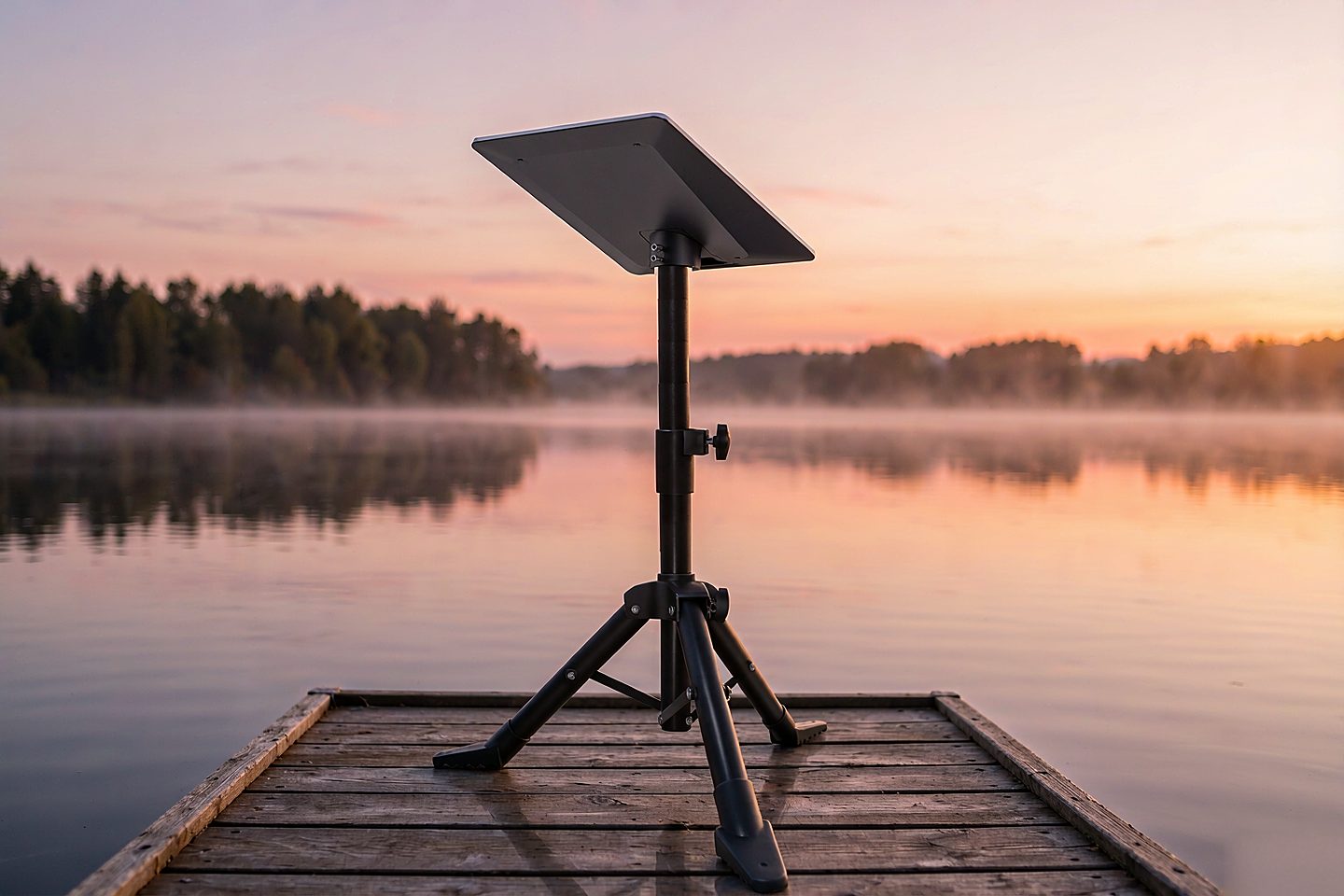
Short version: most boats are better served by a freestanding, weighted stand on the deck than by drilling into the boat. A rail-mount install is the right answer for a small number of hulls — rigid rails, a permanently wired boat, an owner who never trailering — and for everyone else it is holes in fiberglass for a dish that could have sat on a weighted tripod. What decides whether a boat install lasts is not exotic marine hardware: it is rinsing the salt off, ballast against wind, and one watertight cable entry.
This guide covers the three mounting positions honestly, including the one we do not sell. If your Starlink life is mostly land-based with the occasional trailer, the RV setup guide covers the same mobile questions from the campsite side.
What is actually different on a boat
Four things, and none of them are about the dish:
Salt. Salt air is a slow corrosion bath for anything ferrous, and spray is worse than air. The mount, its fasteners and the thread interface all live in it. An install that ignores this looks fine in spring and weeps rust by autumn.
Motion. A boat moves in three axes at once, and a dish on a rigid mount takes all of it. Freestanding setups fail by walking, sliding and vibrating loose — which is a ballast and fastener problem, not a dish problem.
Wind, unimpeded. On open water there is nothing upwind of you. The dish is a flat plate roughly the size of a laptop lid, and at anchor it is a sail. A mount that is fine on a sheltered patio is not automatically fine on an exposed foredeck.
You cannot drill blind. Fiberglass, cored decks and T-tops hide wiring, tanks and structure. A hole in the wrong place is not a patch-of-paint repair. That single fact is why the no-drilling answer wins on most boats.
The three mounting positions, honestly
| Position | How it works | The honest catch |
|---|---|---|
| Hard top / T-top (permanent) | Bracket through-bolted to the canvas top structure, cable run inside a leg | Needs sealing against a real leak path; drilling into cored structure is a one-shot job — get it right or get a marine electrician |
| Deck, freestanding (weighted stand) | Tripod-style stand on the deck, weighted with ballast, dish screws on top | Needs enough weight and a low profile; you take it down when you leave the boat |
| Rail clamp (marine mounts) | Purpose-made stainless clamps onto a pulpit or safety rail | Genuine marine hardware — and we do not sell it. If your rails are rigid and you want permanent, this is the category to buy from a marine chandlery |
We sell the first two honestly and point at the third. A guide that pretends a general-purpose bracket is a marine rail mount is selling you a problem with a bow on it.
Why freestanding wins on most boats
The freestanding answer wins on four counts that matter more on a boat than anywhere else:
No holes. Nothing penetrates the hull or the top. On a boat, "no drilling" is not a preference — it is the difference between an afternoon and a yard bill.
It comes with you. Off the boat at the end of the season, into the car for a lake weekend, onto the dock at the cabin. The mount is portable because the use is portable — the same logic that makes it the answer in the renters guide.
It moves to the view. The spot with the clearest sky is not always where the rail is. A weighted stand goes where the sky is — and the obstruction check on your phone tells you where that is before you commit.
Survives the resale. A boat with four sealed through-bolts through the T-top is a boat with four questions at every survey. A stand leaves nothing behind.
The freestanding setup is the same ask as on land: something solid, level, and clear of the sky. The tripod guide covers the setup itself.
Mini or Standard on a boat?
Both dishes share the same 1.5 inch mount thread, so both work on the same stands — no adapter involved. The difference is weight and sail area:
The Mini is the natural boat dish. It is a fraction of the Standard's weight, which matters twice over: less ballast needed to keep a freestanding setup planted, and less wind loading on the whole assembly. If your boating involves any motion at all, this is the dish that behaves.
The Standard (Gen 3) works too — it just asks more of the ballast and the wind plan. On a hard-top mount with proper fasteners it is a non-issue; on a weighted deck stand it means more weight down low and a lower take-down threshold in breeze.
The mount choice does not change between them. The Gen 3 vs Mini guide runs the full comparison.
Ballast, wind and the take-down call
A freestanding dish on a boat is a sail on a stick, and the failure mode is always the same: it goes over in a gust, usually at 2 a.m., usually attached to the boat by the cable. Three rules cover almost everything:
Weight down low. Ballast on the stand's base — a water jug, a lead bag, the anchor rode — not sandbags balanced on the legs. Low and wide beats high and tidy.
Low profile. Keep the dish as low as the view allows. Every inch of height multiplies the leverage the wind has on it. If the clear-sky window allows a lower set-up, take it.
A take-down threshold. Decide in advance what weather takes the dish down — for most people that is "any sustained breeze over the point where the dish flexes" — and honor it. A dish on the deck in a blow is a projectile; a dish in the cabin is a ten-minute re-setup tomorrow. This is the boat version of the same judgement in the pole and mast guide.
The cable into the cabin
This is the part that separates an install that lasts a season from one that leaks, and it is short: one dedicated entry, sealed, with a drip loop. Never through a door or a hatch — closing edges pinch cable, and pinched cable fails at the connector. Never with the entry hole bored level or upward, which pools water against the seal.
Drill slightly downward toward outside, fit a gland or grommet sized to the cable, seal around it, and leave a drip loop below the entry so water running down the cable falls off before it reaches the hole. Strain-relieve the run inside so a tugged cable does not load the gland. The cable management guide has the full detail, and it is the same job whether the wall is a house or a cabin.
Power inside is the usual next question: a dock feed, a house bank, or a portable station. The off-grid power guide covers runtimes and what actually runs the dish and router all day.
Salt: the maintenance that decides if it lasts
Marine hardware is not magic; it is ordinary hardware plus discipline. Four habits keep a boat install alive:
Rinse with fresh water after salt exposure — the dish, the stand, the thread. Salt holds moisture against metal; fresh water ends that. A two-minute job that doubles the life of everything.
Keep the thread greased. A smear of dielectric grease on the 1.5 inch thread interface stops the galvanic seize that otherwise makes "just unscrew the dish" a two-spanner job next spring.
Check fasteners on a schedule. Vibration walks nuts loose. A monthly look-over on a boat is not optional — motion finds every loose joint eventually.
Store the freestanding parts dry. If the stand comes off at season end, it comes inside. Anything that stays on the boat over winter should at least be covered and closed.
What not to do
Do not use suction cups as the primary fixings. They are a temporary parking solution at best; on a wet, moving deck they are a dish-launching mechanism. If the setup needs to be truly temporary, a weighted stand is still the better answer.
Do not drill the boat blind. Know what is under the surface — wiring, tanks, core — or do not drill at all. The freestanding answer exists precisely so you never have to find out the hard way.
Do not leave it up in weather. The dish is a sail; the boat is not a building. Take-down discipline is the single biggest reliability factor in the whole setup.
Do not buy "marine" marketing. A rail clamp from a marine chandlery is real marine hardware. A general mount in a silver box with a boat on it is not. If a permanent rail install is genuinely what you need, buy it from the marine category — the rest of this guide still applies to the cable and the dish.
Our line, for the boat
The tripod stand is the honest boat answer for most hulls: freestanding, so nothing gets drilled; weighted, so it stays planted; and it takes the dish's 1.5 inch thread directly — Mini or Standard, adapter included in the box. On a hard-top install where you have decided to fix it permanently, the wall bracket and roof kit do the job they do on buildings — with the sealing discipline from the cable guide above. And when the dish is settled, the router guide finishes the cabin side of the install.
FAQ
What is the best way to mount Starlink on a boat?
For most boats, a freestanding weighted stand on the deck. Nothing gets drilled, the setup moves to the clearest view, and it comes off the boat at the end of the season. Permanent rail or hard-top mounts are the right answer only when you have rigid rails or a boat that is never going to move.
Do I need a marine rail mount for Starlink?
Only for permanent installs on boats with rigid rails - and that is real marine hardware sold by marine chandlers, not something we stock. For anchored use, seasonal use, or any boat you trailer, a weighted freestanding stand is simpler and leaves no holes.
Will saltwater damage a Starlink mount?
It will if you ignore it. Rinse the dish, stand and thread with fresh water after salt exposure, keep the 1.5 inch thread greased with dielectric grease, and check fasteners monthly. With that discipline an ordinary mount lasts years in salt air; without it, rust finds every joint.
Can I leave Starlink on my boat all season?
A hard-top install can stay. A freestanding deck setup should come down in heavy weather and at season end - decide a wind threshold in advance and honor it. A dish left up in a blow is a sail, and the cable will not hold a boat-sized gust.
Does Starlink work on a boat underway?
It works best at anchor or stationary with a clear view of the sky. Underway, performance depends on speed, sea state and horizon view - expect interruptions in chop and when the view is blocked by the boat's own structure. Plan around it as a mobile solution, not a fixed one.
Can I use Starlink Mini on a boat?
Yes, and it is the natural boat dish. It shares the same 1.5 inch mount thread as the Standard, so the same freestanding stands work, and its lower weight means less ballast and less wind loading on the whole setup.
Tripod Stand
Freestanding and weighted - no holes in the boat, takes the dish's 1.5 inch thread directly, adapter in the box.