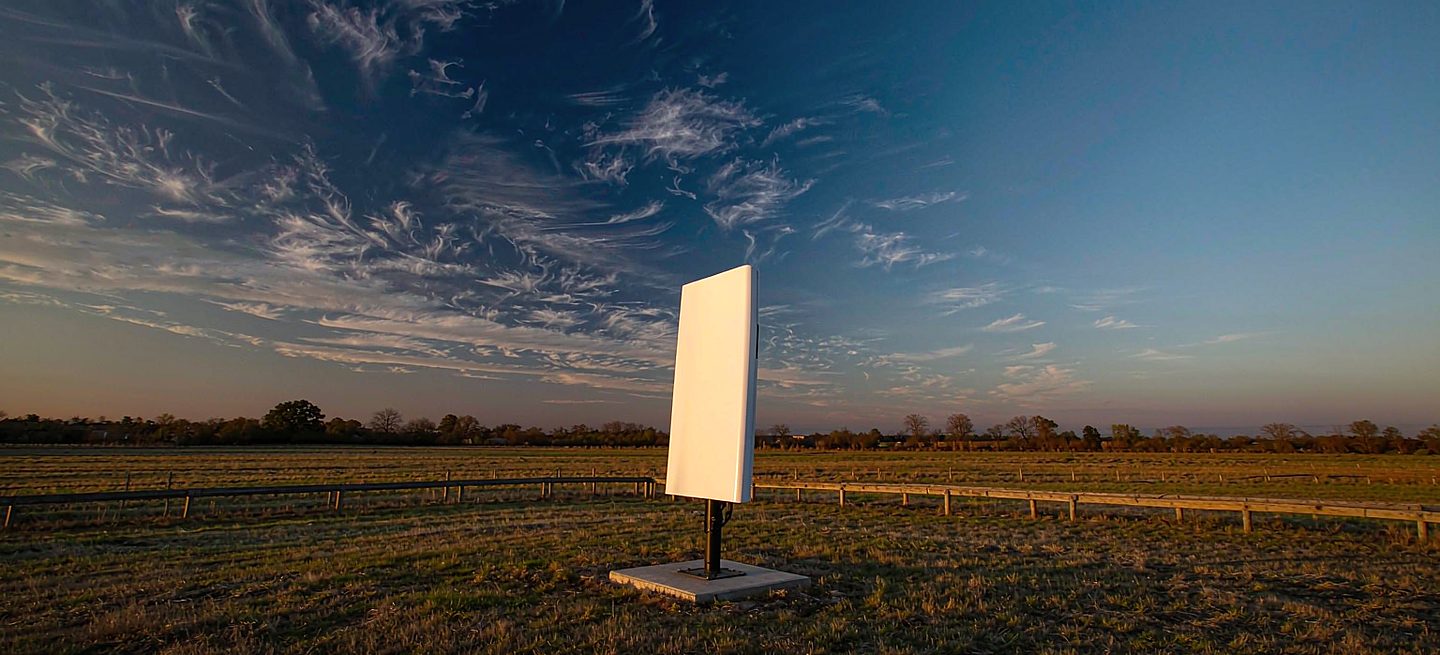
Short version: an obstruction is an angle, not a height, and that single change of framing answers the question. What blocks your dish is how much sky an object covers as seen from where the dish sits — which depends far more on how far away the object is than on how tall it is. Raising the dish shrinks that angle, but the amount you get back falls away fast with distance: against a fence ten metres away it is worth doing, against a tree line sixty metres away you would need to lift the dish several metres to notice.
So before you buy a taller mast, work out what kind of obstruction you actually have. If you have not settled on a mount type yet, the buying guide narrows that down first; this article is about the site itself — and specifically about the assumption that going up is the answer.
Two numbers, and only one of them is on your side
The first number is the field of view: not a narrow beam, but a broad region of sky the dish needs to work with. Anything inside that region takes something away from it. The second is the angle an obstacle occupies in that region, and it is set by two things: how far the top of the obstacle sits above the dish, and how far away the obstacle is.
Roughly, the angle is the height difference divided by the distance. Which gives the rule that surprises people: double the distance and you halve the angle. The same tree that eats a big slice of the view from fifteen metres away is a much smaller problem from thirty — even though nothing about the tree changed.
This is why "how high should the dish be?" has no clean answer. Move the dish one metre sideways and the obstacles in front of it are a different set of obstacles at different distances. The question is really "how much sky does my site leave me?", and height is only one of three ways to change the answer.
The three moves, ranked by what they cost you
| Move | What it changes | Best against | Sketch of the cost |
|---|---|---|---|
| Shift sideways | The compass direction you are looking along | A narrow obstacle: one tree, a chimney, a post | Zero — walk the dish around and re-check |
| Raise the dish | The vertical angle over an obstacle | Something close and low | A longer mast, more cable, wind load, harder access |
| Change side of the building | The whole set of obstacles in view | A view blocked across its entire width | Cable routing redone, new fixings, the biggest job of the three |
Worked out: why distance decides everything
Two examples using the same starting height. Both the fence and the tree line stand above the dish; the only difference is how far away they are.
Near. A fence with its top two metres above the dish, ten metres away. The angle it occupies works out at roughly 11°. Raise the dish by one metre, so the fence now stands only one metre above it, and the angle drops to roughly 6°. That is a large improvement for one metre of mast, and it is the case where height genuinely is the answer.
Far. A tree line with its top ten metres above the dish, sixty metres away. The angle works out at roughly 9.5° — a similar starting problem. Raise the dish by one metre and you get roughly 8.5°. You paid for a taller mast, a longer cable run and more wind load, and bought one degree. To halve that angle you would need the top of the tree line to sit five metres below where it is now — meaning the dish has to go up by about five metres, which is no longer a mount, it is a structure.
And here is the part that settles the argument: at sixty metres, shifting the whole installation one metre sideways changes the viewing geometry by about the same one degree as raising it one metre. Same gain, one of them free. A freestanding stand is the only type of mount that lets you make that move casually — walk it five metres across the yard, look at the check again, and keep walking until the picture clears.
What changes when you go up, beyond the view
Height is usually discussed as though it were free, and it is not. Every metre you add changes four other things.
The cable run. Dish cables come in fixed lengths, and a mast tall enough to matter usually means a longer run and a joint somewhere outdoors — which is a water-ingress point you did not have before.
The wind load. Wind speed rises with height above ground, and a longer mast also gives the same wind more leverage over the fixing at its base. Height and the strength of the mounting point are not independent decisions.
Your ability to reach it. Re-aiming, clearing snow, taking the dish down ahead of a storm — all of it gets harder, and the last one is the one you will want to do at short notice.
How it looks. A dish on a two-metre stand reads as garden furniture. The same dish at five metres is a mast, and neighbours and site rules tend to notice masts.
When height really is the right answer
None of this makes height useless — it makes it specific. Reach for it when the obstacle is close:
Low obstacles near the dish. A fence, a low wall, a hedge, the eaves of your own house, the roof of a parked vehicle or RV. These are the cases where one or two metres changes the angle substantially.
Ground that sits low. A yard that falls away, a hollow, a dish placed at the bottom of a slope: terrain takes a bite out of the field of view before any tree or building does, and raising the dish recovers it. It is easy to miss because ground does not look like an obstruction.
Seeing over your own house. If the alternative is looking across your own roof to reach open sky, a modest lift can be better than moving to the far side of the property — though if the roof itself is the problem, the side you mount on matters more than the height you mount at, which is the point of wall versus eave. And if you do end up going through a roof covering to gain that height, the roof-type article sets out what each covering tolerates.
Where people go wrong
1. Buying the tallest mast before trying anything else
Walking the dish around the yard costs an afternoon and nothing else. A mast costs money, wind load and cable. Do the free thing first — the two worked examples above are the reason.
2. Scanning from where it is convenient to stand
The check has to be run at the dish's real position and its real height. Run it from ground level when the dish is going on a roof, or from the front path when the dish is going round the back, and the reading describes a site you are not installing on.
3. Fixing the site once and never revisiting it
Deciduous trees block heavily in leaf and barely at all in winter; trees grow; a neighbour extends. A site that checked out in February can fail in July. If your connection degrades seasonally, re-run the check before you buy hardware to fix a problem you have not measured.
4. Expecting the dish to point its way out of trouble
The dish works within the field of view it has been given, and it will not reposition itself just because something is in the way. Obstruction is a property of the site, not of the pointing — so the fix has to be at the site.
5. Judging the site from the ground on a slope
On a slope, the flat-looking spot often has the worst view, because the ground is angled the same way your line of sight is. Walk the whole property before choosing, and check both the direction that looks open and the direction you will actually need.
FAQ
How high does a Starlink dish need to be?
There is no universal number, because what blocks a dish is an angle rather than a height. That angle depends on how far above the dish an obstacle stands and how far away it is — a shed six metres away can cost you more sky than a house sixty metres away. Run the check in the app at the dish's real position and real height, and treat that readout as the answer.
Can I fix an obstruction by putting the dish on a taller pole?
Against something close and low — a fence, a low wall, your own eaves — yes, and it works well, because the angle shrinks quickly. Against something far away, each extra metre of height removes roughly a degree, so a tall mast buys very little while adding cable length, joints and wind load.
Will a taller mount finally clear a tree?
Move sideways first. A single tree fills a limited slice of the field of view, so a few metres across can take it out of the picture entirely, while raising the dish only lifts your line of sight over something that is still in it. A continuous tree line is a different problem, and height rarely solves it.
Does the dish need a completely clear view?
The check in the app reports what is actually inside the field of view at your site, and that readout is the one worth trusting — run it from the installation point at the installation height, then judge it against how the connection behaves in practice. Readings taken from the ground rarely match what the dish sees once it is up.
Is a roof mount worth it just for the extra height?
Only against nearby obstacles. A roof typically adds a couple of metres, which is real progress over a fence or your own eaves and close to nothing against a tree line a street away — where you would be drilling through a roof covering to buy a fraction of a degree. What each covering tolerates decides whether that trade is available at all.
What about the ground the dish stands on?
Slope counts as obstruction. A dish set low in a yard that falls away, or in a hollow, starts with part of its field of view already taken by terrain, which is easy to overlook because terrain does not look like a building. Move uphill, or raise the dish off that ground.
Send us the site, not the dish
Photos of the direction you need to look along, plus roughly how far away the nearest tall thing is, tell us more than any meter reading. We will tell you whether height is worth buying here, or whether the answer is to move the dish a few metres and keep your money. If a raised position is the right call, the stand's mast adjusts and moves with the site; if the site is fixed and permanent, the roof kit is the version that stays put.