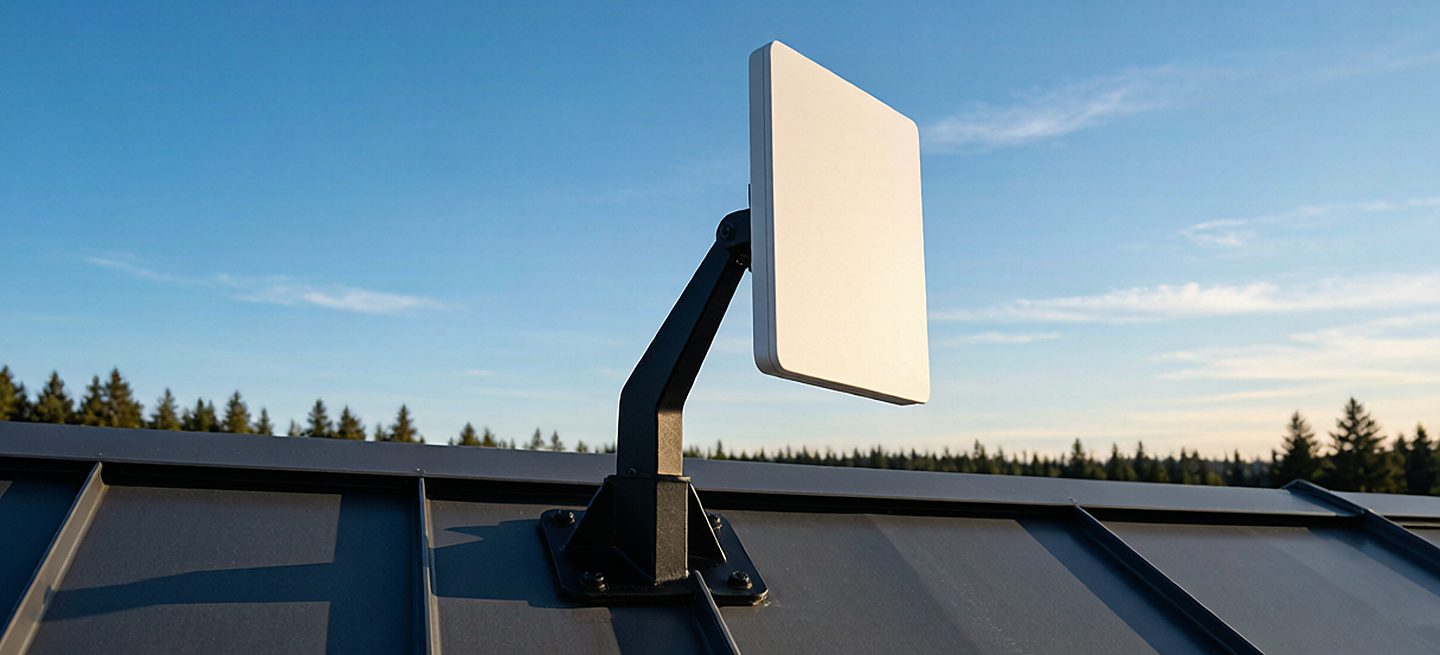
Short version: the material on top of your roof matters less than you think. What decides whether a mount holds is how the bracket is fixed, and that splits roofs into three groups, not three materials — a roof you can clamp a seam on, a roof you have to screw through into structure, and a roof where bolting anything down is the wrong move.
Most guides treat this as a shopping question: pick your material, buy the matching part. It is not, because two roofs that look completely different can take the same fixing, and two roofs that look identical can take different ones. This article sorts that out. If you have not picked a position yet, the buying guide narrows the field first.
The three groups, side by side
| Roof | How the mount fixes | Penetrates the covering? |
|---|---|---|
| Standing seam metal | A clamp grips the raised seam; nothing else is touched | No |
| Corrugated / R-panel metal | Screwed through the sheet into purlins or rafters, gasket under each fastener | Yes |
| Pitched shingle or tile | Screwed through the covering into a rafter, sealed at the fixing | Yes |
| Flat or very low slope | Weighted freestanding stand — no fixing into the roof at all | No |
Why the material is the wrong question
Two metal roofs can belong to different groups. A standing seam roof has raised ribs a clamp can grip, so it takes the same non-penetrating approach as an eave bracket. A corrugated or R-panel roof is a flat-ish sheet with no rib to hold, so it takes the same screw-through approach as a shingle roof. Same material, opposite fixing.
And the reverse is true as well: a metal roof and a shingle roof, once both are in the screw-through group, need the same mount. The material changes what you seal against, not what holds the bracket. That is why searching for a mount by material keeps sending people to the wrong part.
The question to answer first is simpler: is there a raised seam for a clamp, and is there solid timber under the surface? Everything else follows from those two answers.
What the bracket has to reach on each roof
Across all three groups the load path is the same: wind arrives as a lever, and the fixing has to carry that lever into the structure of the building. What changes is what "structure" means.
Standing seam metal — the seam itself is the structure, because the panels are folded from a single sheet and the rib is stiff. The clamp has to match the seam profile and be wide enough not to crush it. Measure the seam before ordering; profiles differ between manufacturers, and a clamp that is slightly too narrow will feel tight while gripping almost nothing.
Corrugated or R-panel metal — the sheet is thin and carries no load by itself. The fastener has to pass through it and into the purlins or rafters underneath, which means finding them first. Every fastener needs a seal, and the seal has to be a proper gasket rather than a blob of sealant, because the sheet expands and contracts with temperature and a rigid seal will crack.
Shingle and tile — the covering is a weather layer, not a structural one. The fixing has to reach the rafter, or at minimum solid decking, and never stop in the shingle. Find the rafter by tapping for the solid rhythm, or by locating the nails of the course above. This is the same job a roofer does for a vent, and the sealing principle is identical: the hole is protected above and below.
Flat roofs: the case where the answer is not a roof mount
A flat roof breaks the pattern, and it is where a bolted roof mount does real damage.
There is no pitch to shed water, so any penetration sits in standing water rather than running clear of it. There is usually no rafter tail at a convenient angle to bolt through, because the roof edge is a parapet or a drip edge rather than a fascia. And the surface is often a membrane — EPDM, TPO or a built-up layer — where a fastener creates a puncture that has to be patched with the same material, not with sealant.
On a flat roof the honest recommendation is a weighted freestanding stand: nothing touches the membrane, the whole install sits on top of it, and if the position is wrong you can simply move it. It is also the only option that adapts when the obstruction picture changes.
Wind is the trade-off. A freestanding stand depends on ballast rather than fixings, so on an exposed flat roof it needs enough weight and it needs the mast low. If the roof is high and open to prevailing wind, that combination is worth taking seriously before choosing it — the freestanding article covers the wind case in detail.
What makes a roof mount fail
1. Fixing into the covering instead of the structure
The most common failure on any roof type. A screw that holds shingle, or sheet metal, is holding the part you are supposed to be protecting. It has to reach timber, purlin or a structural layer beneath.
2. Sealing the top of the hole only
Water does not only arrive from above. On a pitched roof it runs down the fixing and can track in at the underside, and on metal it also moves sideways as condensation. The joint has to be sealed where the fastener enters and where it leaves.
3. Assuming "metal roof" means one thing
The reason this article exists. Standing seam and corrugated panels are both metal and take opposite approaches — clamp versus screw. Buying by material alone gets it wrong half the time.
4. Putting the dish where the roof, not the sky, allows
A mount can be perfectly installed and still useless if the dish ends up looking over the ridge or into a chimney. Decide the position from the obstruction picture first, then work out how to fix it there — not the other way round. Which side of the house matters as much as which roof.
5. Buying to the lighter dish
The mount thread is shared between the Standard dish and the Mini, so the same bracket physically fits both, and the load is nothing alike — the Standard dish is roughly four times the weight and catches far more wind. If you may own both, buy to the heavier one; the Gen 3 vs Mini comparison settles which hardware you have.
FAQ
Can I mount a dish on a metal roof without drilling?
On a standing seam roof, yes — a seam clamp grips the raised rib and nothing is pierced. On corrugated or R-panel metal there is no rib to grip, so the fixing has to be screwed through the sheet into the timber below, with a gasket under each fastener.
Will screwing into a shingle roof cause a leak?
Not if the fastener lands in a rafter and is sealed properly. Shingle roofs are already full of penetrations for vents and stacks, all held on the same principle: seal above and below, and fix into structure rather than into the shingle.
What is the best mount for a flat roof?
A weighted freestanding stand. There is no pitch to shed water and no rafter tail to bolt through, so a penetration there is harder to seal and harder to reach. Ballast keeps everything above the membrane.
Which roof type is easiest to install on?
A pitched shingle roof — rafters are regular and simple to screw into, and the hardware is the most widely available. Standing seam is easy too but needs a clamp rather than a screw. Flat roofs are the ones that call for a different approach.
Do I need a pipe adapter for a roof mount?
Only if the mount does not already end in the right thread. Both current dishes take a 1.5 inch pipe thread, and a mount built with that thread needs nothing between it and the dish. Ours are built that way.
Tell us your roof, we will tell you the fixing
Two photos are enough: the roof surface from a few steps back, and a close-up of the edge or the seam. We will tell you which group your roof falls into, whether a clamp or a screw applies, and if a freestanding stand is the better answer for your case. It takes a minute and saves a return.