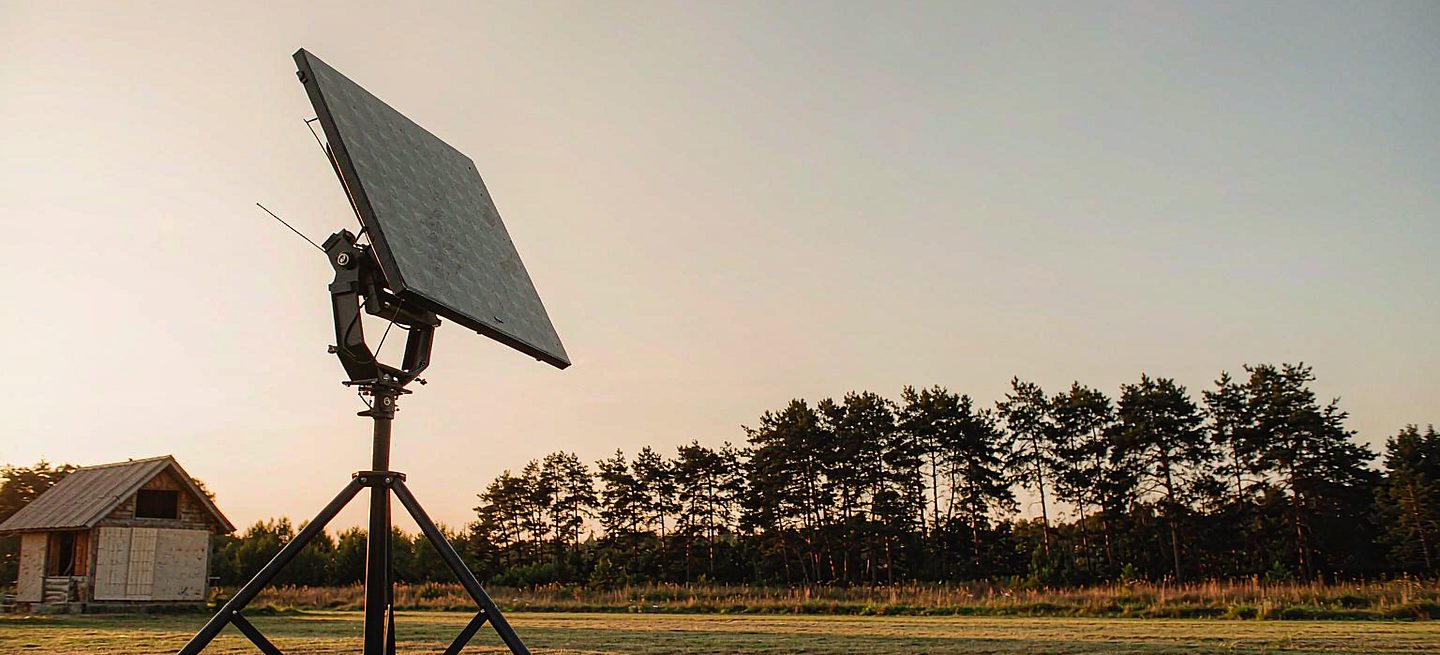
Short version: a freestanding stand wins in four situations — you do not own the building, the roof cannot be perforated, the sky you are aiming at keeps changing, or you have not yet worked out where the dish belongs. It loses in exactly one: you own the building, you already know the spot, and nothing about that spot is going to move.
Most buying guides treat a stand as the compromise you accept when drilling is ruled out — one of four ways to mount without drilling, and usually filed under "temporary". That undersells it. A stand is the only mount that lets you test a position before you commit to it — and with a dish that needs a wide, unobstructed view, the position matters more than the fixing. Two metres to the left is often the difference between a clean view and a dish that drops out every time a satellite crosses the tree line.
What a stand is actually good at
| Your situation | Why a stand wins | What to watch |
|---|---|---|
| You rent, or the lease forbids modification | Nothing is fixed, so nothing has to be repaired or negotiated at move-out | A loose object outdoors can be shifted by wind, by weather, or by people |
| Standing-seam metal, slate, or a membrane roof | No penetration means no leak you have to own for the life of the install | Fixing onto those roofs is a specialist job anyway — this routes around it |
| A tree line, hedge or new build in your line of sight | Re-aiming takes minutes, and needs no new holes | Check the aim after the first serious storm of the season |
| You have not chosen the spot yet | You can walk the dish around the yard and read the obstruction map in real time | Use it to decide the position, then decide whether you still want a bracket |
What a freestanding stand trades away
Three things, and they are all real.
It leans on the ground. The legs need level ground within a few degrees, and the base needs a footprint wider than most people expect. Independently adjustable legs cover a lot of ground, but a slope is still a slope — on a serious incline you are stacking timber under a leg, which is the point at which most installs start to look improvised.
Wind becomes the whole problem. A stand has no fasteners, so everything the dish catches has to be carried by mass or by ground anchors. Wind load rises with the square of wind speed, which means the load in a February storm is far beyond anything you can produce by pushing the base with one hand. On paving or concrete, ballast across the base does the work. On grass, gravel or anything that softens after rain, ground anchors do it better. A stand that is stable on a calm afternoon tells you nothing about the day you actually need it.
Height is on you, not on the building. A roof or eave bracket lifts the dish above the roofline for free. A stand has to get there with a telescoping mast and a clear patch of ground to stand on — which is fine, as long as you check the view from the top of the mast rather than from the ground next to it.
One more, which has nothing to do with physics: the dish is now standing in your yard. It can be walked into in the dark, driven over, or picked up and carried away. If that matters, a bracket is the answer regardless of how good the ground is.
Use the stand to find the spot you might eventually drill
This is the argument that convinces most people who were never going to be talked out of a permanent install.
The obstruction map in the app only knows what the dish can see from where the dish is. Mount a bracket first and you have committed to a position based on a guess made while standing in the garden, looking up, with no feedback. Mount the dish on a stand first and you get the real answer: how much of the sky is visible, whether that tree matters, whether the corner by the fence is better than the spot you had in mind.
Then you decide. Plenty of installs stay on the stand permanently because the position turned out to be good and nothing is ever going to move. Others end with a bracket in exactly the right place — chosen with evidence rather than by eye. Either way you bought the same stand once.
What makes a freestanding install fail
1. Judging the base by hand
Pushing a base and feeling it resist proves nothing. If you cannot calculate the load, buy margin: a heavier base, a wider footprint, or ground anchors as a second line of defence.
2. Anchoring nothing on soft ground
Soil that is firm in August is mud in March. On grass, gravel or sand, ballast alone is a bet — ground anchors are what stop a stand from walking out of position over a winter.
3. Running the cable across open ground
A stand puts the dish where a cable has to cross a lawn, a path or a doorway. It gets mown, stood on, or pinched in a door that still has to close. Plan the cable route the same way you plan the dish position, and keep enough slack to move the stand a metre without unplugging anything.
4. Setting it and never looking at it again
A fixed bracket holds its aim until something fails. A stand holds its aim until something touches it — a storm, a wheelbarrow, the dog. Re-check the aim after the first big weather of each season, and check that the mast is still vertical rather than assuming it is.
5. Assuming a mount rated for Mini will carry the Standard dish
The mast thread is shared, so almost everything physically fits. The load is not shared: the Standard dish is roughly four times the weight and catches far more wind. If you might own both dishes, buy to the heavier one — the Gen 3 vs Mini comparison settles it in about thirty seconds.
FAQ
Is a freestanding tripod stable enough for permanent use?
Yes, if the ground is level and the base is held down properly — ballast on a hard surface, anchors on soft ground. The failure mode is almost never the stand itself; it is an under-built base.
Do I still need ballast if the base already feels heavy?
Yes. Your arm is not a wind test. Load rises with the square of wind speed, so a winter storm applies many times the force you can produce by leaning on the base.
Can I use a tripod on a balcony or a wooden deck?
Yes, and hard surfaces are the easiest place to use one. Just check that the deck does not flex under load, and that the cable reaches without becoming a trip hazard or getting crushed in a door.
Will the same stand carry both the Standard and the Mini dish?
Physically, yes — the mast interface is the same. But the Standard dish weighs about four times more and catches far more wind, so check the rating rather than the fit. The stand comes in a standard size and an extra-large size for exactly this reason.
Do I need to buy a pipe adapter as well?
Only if the mount does not already end in the right thread. A pipe adapter exists to bridge a dish to a pole, and both current dishes take a 1.5 inch pipe thread. If the mount is built with that thread, there is nothing between the two to buy. Ours are built that way, and the tripod ships with the adapter in the box.
Still not sure a stand is the right answer for your place?
Send us the model number from the label on the back of the dish, plus a photo of where you would put it — garden, deck, balcony, flat roof. We will tell you whether a freestanding install holds up there, or tell you that what you already have is fine. It takes a minute and saves a return.