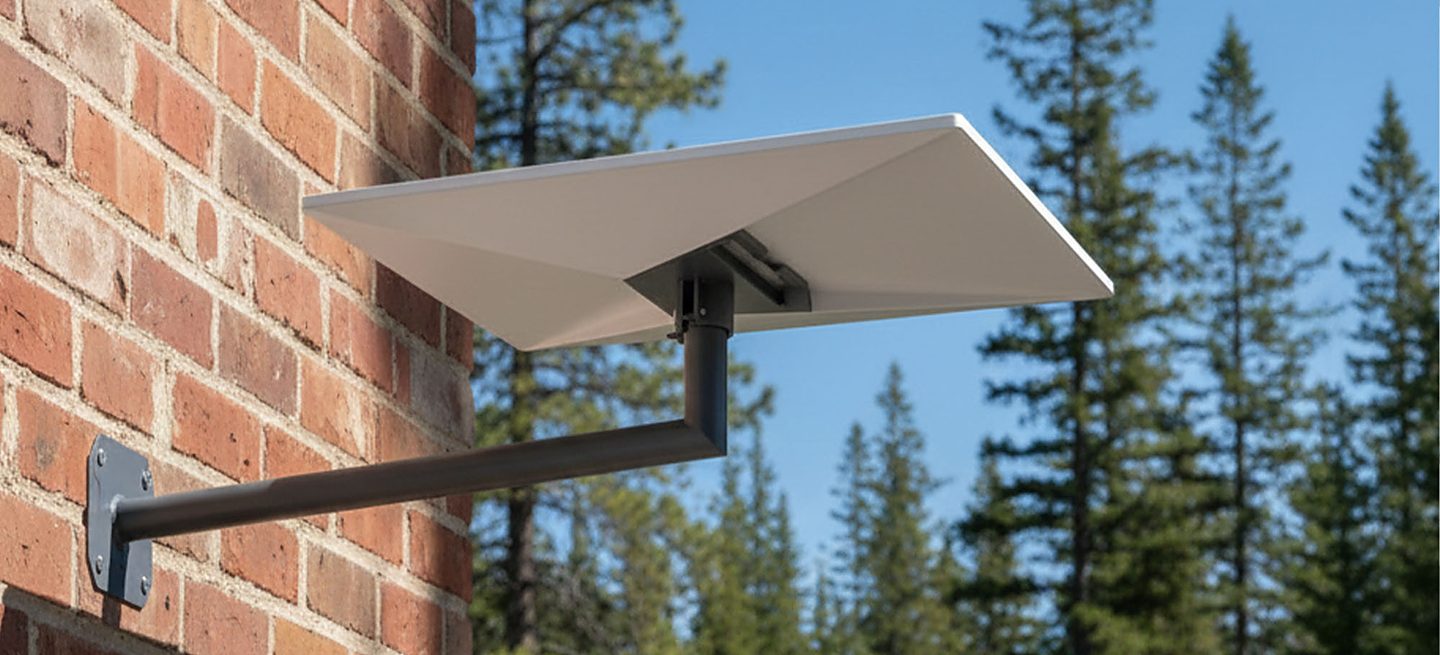
Short version: there are exactly four ways to get a dish up without putting a hole in your building — a freestanding stand, an eave or fascia bracket, a clamp on a structure that already exists, or nothing but weight. Which one is right for you comes down to two questions: do you own the building, and does the spot you have in mind get a clear view of the sky?
One thing is the same across all four: the dish-to-mast interface. If you are unsure which dish you own, the difference is weight rather than thread — the Gen 3 vs Mini comparison settles it in about thirty seconds.
The four options, side by side
| What you have | The no-drill option | What actually holds it | Best for |
|---|---|---|---|
| A yard, deck, balcony or open ground | Freestanding stand | Its own base, plus ballast or ground anchors | Renters, moving house, seasonal setups |
| A gable end, fascia, or a wall you can fix into | Wall / eave bracket | Screws into the wall face or fascia board — never the roof covering | A permanent install that wants height and tidiness |
| An existing mast, fence post, railing or rack bar | Clamp or strap mount | Whichever structure is already there | A quick, cheap, fully reversible fit |
| A flat roof, concrete pad or solid deck | Ballasted base | Dead weight — no fasteners at all | Flat roofs and hard surfaces with no fixing points |
1. A freestanding stand — the only genuinely zero-fix option
A stand is the one solution that involves no fasteners, no anchors and no permission from anyone. It stands on the ground, holds the mast at a usable height, and folds away when you leave. Nothing about your building changes.
What it does need is ballast or ground anchors. The stand itself is a frame; the wind is what moves it. On a hard surface, weight across the base does the job. On grass or gravel, ground anchors do it better. This is where most no-drill installs quietly fail — a stand that is stable on a calm Tuesday tells you nothing about a storm in February.
Practical notes worth knowing before you buy one: the legs need level ground within a few degrees, the base needs to be wider than you expect to resist tipping, and a telescoping mast lets you chase a clear view without moving the whole assembly. If you are renting, or you expect to move within a year or two, this is usually the answer.
2. An eave or fascia bracket — permanent, and the roof stays intact
This is the option people miss. You can have a permanently fixed dish without touching the roof covering at all — the bracket goes into the wall face, the gable end, or the fascia board that runs along the edge of the roof, and the load travels into the frame of the building instead of through the water seal above your ceiling.
For anyone with tile, slate, shingle or a metal standing-seam roof, this is often the better install regardless of whether drilling bothers you. A penetration through a roof covering is a leak risk you have to maintain for as long as the dish is up. A bracket into a vertical surface is not.
Two conditions matter. First, the surface has to be structural — a fascia board, a gable wall, a stud behind siding. Second, the hardware has to match the material: timber takes lag screws, brick and stucco take sleeve anchors, and thin cladding needs a bracket that spreads load across a wider area than a single bolt. A bracket that ships "one fixing for every surface" is the bracket you will be re-tightening next season.
3. Clamp onto something that is already there
If a mast, fence post, railing, balcony rail or vehicle rack bar already exists, a clamp turns it into a dish mount in minutes — no new holes anywhere, and it comes off just as easily. Cost is usually lowest of the four options.
The catch is that you are now relying on a structure built for a different purpose, and its load capacity is unknown. A fence post is not designed for wind load plus a dish. A rail designed for a hand's weight is not necessarily rated for a sail in a gale. If you can wobble it by hand, it is not a mast — and if the clamp can creep along the bar, your aim will drift.
4. Ballast: weight instead of fasteners
On a flat roof or a concrete pad, you can skip fasteners entirely and hold the mount down with mass. It is the standard approach on commercial roofs for exactly the reason it appeals to homeowners: nothing is pierced, so nothing can leak.
The mistake is treating ballast as a formality. Wind load rises with the square of speed, so the same base that shrugs off a breezy afternoon is nowhere near enough for a winter storm — and the load lands on whatever is under the base, which is often a roof membrane you are trying to protect. Use a mat or pads under the weights rather than setting blocks directly on a soft covering, keep the weight low and spread wide rather than stacked high, and re-check after the first serious weather.
What makes a no-drill install fail
1. Fixing to a rain gutter
The most common bad idea in this category. Gutters are drainage channels — they carry water and their own weight, nothing more. Hanging a dish on one puts load on brackets designed to hold a fraction of it, and the failure mode is a section of gutter on the ground with your dish attached to it.
2. Ballast that is heavy enough to look convincing and not heavy enough to work
A base that does not move when you push it is not a wind test. If you cannot calculate the load, buy margin: a heavier base, a wider footprint, or ground anchors as a second line of defence.
3. Solving for "no holes" and creating an obstruction instead
A dish with a partly blocked view does not degrade gracefully. It works fine, then drops out completely whenever a satellite crosses the blocked sector — which tends to be the moment you actually need it. A stand in the right place beats a bracket in a convenient one.
4. Assuming a mount rated for Mini will carry the Standard dish
The mast thread is shared, so almost everything physically fits. The load is not shared: the Standard dish is roughly four times the weight and catches far more wind. If you might own both dishes, buy to the heavier one — the buying guide walks through that decision.
FAQ
Can Starlink be installed without drilling at all?
Yes. A freestanding stand is the only option with no fasteners of any kind. An eave or fascia bracket also leaves the roof untouched, but it does put screws into a wall or fascia board.
Is a freestanding stand stable enough long-term?
On a hard, level surface with adequate ballast, yes — and it is the more forgiving option for a lighter dish. On soft ground, add ground anchors and plan to re-check the aim after the first storm.
Can I clamp the mount to a rain gutter?
Don't. A gutter is a drainage channel, not a structural member, and it will pull away from the fascia long before it is carrying the load a dish applies.
Does a no-drill mount work with both the Standard and the Mini dish?
Physically, yes — the mast interface is the same. But check the rating rather than the fit. The Standard dish weighs about four times more and catches far more wind, so a mount rated only for Mini is the wrong bracket for it.
Still not sure which option fits your place?
Send us the model number from the label on the back of the dish, plus a photo of the spot you have in mind — ground, eave, wall, flat roof. We'll tell you which of the four applies, or tell you that what you already have is fine. It takes a minute and saves a return.