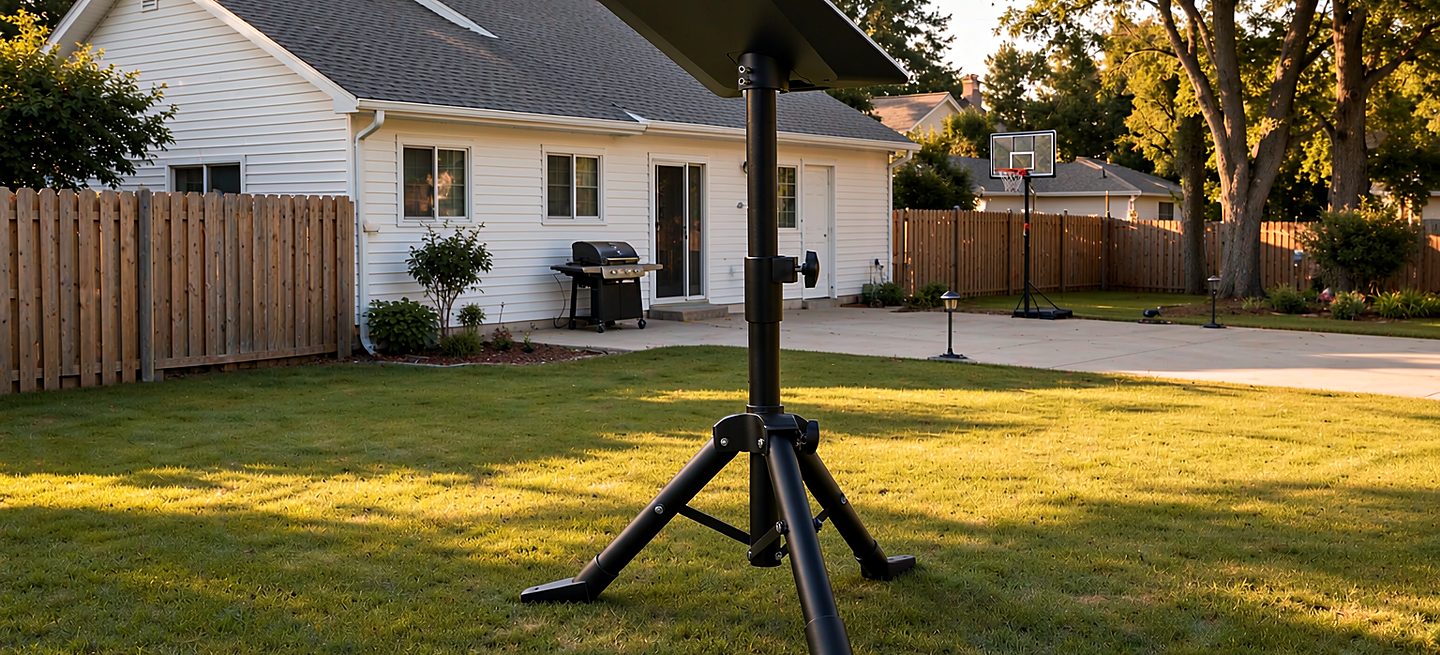
Short version: a ground mount has exactly one engineering problem — tipping — and everything else follows from it. The dish catches wind like a sail, the mast is a lever, and the only things resisting are mass (ballast) and bite (stakes or anchors) at the feet. Get those two right for your soil and your season, and a tripod in the backyard is the most robust install on this whole site. Get them wrong, and it does not fail in a storm — it fails quietly over weeks, one leg sinking at a time.
This guide is the ground half of the no-drill options — that page picks between stands, clamps and ballast; this one is about making the ground choice actually hold. If you are renting, the renters guide covers the clauses that matter first. And if the reason you are on the ground is permission rather than physics, the ground is also the permit-free answer — a tripod with no penetration usually sits outside every approval process, which the permits guide runs through.
Why people end up on the ground at all
Nobody picks a yard mount for the view — the roof is almost always higher. They pick it for one of three reasons, and each one sets a different priority:
There is nothing to fix to. Renters, metal roofs too thin to trust, old shingles you do not want to pierce, or a wall that belongs to the neighbour. The ground is the only surface that is genuinely yours.
You are still testing the position. Until the obstruction check has run from the actual spot, a fixed mount is a bet. A freestanding stand lets you move the dish across the yard for a week and commit afterwards — see the obstruction guide for why moving sideways usually beats going up.
The roof is the wrong roof. Some surfaces — aging membrane, decorative tile, a flat roof you cannot walk safely — are better left alone. A yard mount converts a roofing project into a lawn project.
The physics, in one paragraph
Wind pushes the dish sideways; the mast turns that push into a tipping moment. Two things resist: the weight of ballast, and how far out from the mast that weight sits. This gives the two rules that govern every ground install. Ballast belongs on the outer feet, not around the mast — a hundred pounds stacked at the centre does far less than the same hundred spread at the leg ends, because what matters is weight times distance, not weight. And height is the enemy: the taller the mast, the more leverage the wind gets, so the cheapest stability upgrade is usually taking the dish down a section, not adding weight.
Ballast: how much, and where
Ballast is not a formality, and it is not a number you can copy from a forum — the right mass depends on your mast height, your local wind and your soil. What you can copy is the placement and the habits:
Spread wide and low. Weight distributed at the leg ends beats the same weight stacked at the base, every time. If your stand has points for it, hang or sit weights on the outer feet; if not, a mat with blocks at the corners does the job.
Use dense, weatherproof mass. Concrete blocks, paving slabs and sandbags all work. Water-filled weights do not, in a climate that freezes — ice expands, containers split, and you find out in spring with a puddle where your ballast was. If water is all you have, plan on emptying it before the first frost.
Protect what is underneath. Blocks sitting directly on a deck, a membrane or good lawn leave marks. A rubber mat or paving pads under each contact point spreads the load and saves both the surface and your deposit.
Re-check after the first serious weather. Ballast that survived a breezy afternoon is not proven. The first real storm is the test, and it is much cheaper to walk outside and look than to discover the result from the outage log.
Stakes and anchors: when the ground helps, and when it lies
Stakes are the opposite trade from ballast: free, invisible, and completely dependent on the soil. The honest guide to when they work:
| Ground | Do stakes hold? | What to do instead |
|---|---|---|
| Firm clay or compacted soil | Usually yes — the stake bites and stays | Stakes plus modest ballast for storms |
| Ordinary lawn topsoil | Partly — holds in calm, works loose when saturated | Ballast-first; stakes as backup |
| Sand or gravel (beaches, riverbanks) | No — sand has nothing to grip | Ballast only; this is the boat-deck case |
| Rock, concrete or decking | Nothing to drive into | Ballast plus non-slip mats |
| Frozen ground in winter | Only until the first thaw | Ballast; stakes come out in spring |
Spiral ground anchors hold better than straight U-pins in looser soil, and both are cheaper than any mount — a hardware store visit, not a purchase from us. We do not sell stakes, and we never will: they are commodity hardware and your local store has the type that matches your soil.
The ground itself: frost, mud and lawn
Most yard-mount failures are not wind failures. They are ground failures, and they are seasonal:
Frost heave. Freeze-thaw cycles lift the ground unevenly, and a leg sitting on lifted soil ends up an inch off the ground — or an inch into it. The stand does not crash; it slowly tilts until the dish points at the trees. Two habits prevent it: set the stand on frozen or well-drained ground rather than fresh loose soil, and re-level every spring, because heave is a winter-long process you cannot watch.
Rain and mud. Saturated soil stops holding stakes and starts swallowing feet. If a leg sinks after rain, that spot is telling you something — move to a compacted area, or lay a small gravel or paver pad so the load spreads instead of punching in.
Lawn care. A tripod on grass is fine for weeks, but the grass under the feet is being shaded and pressed. Wide feet beat narrow feet, and if you want zero turf damage, a light paver or stepping-stone under each foot keeps the lawn alive underneath. Mowing around the legs is a two-minute job; mowing into them is how masts get bent.
What actually knocks a yard mount over
| Failure | Early sign | Fix |
|---|---|---|
| Ballast too light, or stacked at the centre | The stand shifts in gusts it used to ignore | Move the weight to the outer feet |
| Frost heave under one leg | Slow signal drift over winter | Re-level in spring; stand on frozen or drained ground |
| Feet sinking in mud | Rings of disturbed grass, lean after rain | Paver pad or compacted spot; ballast-first thinking |
| Installed on a slope | It never sat quite right from day one | Move it — no ballast fixes a slope |
| Collision: mower, dog, basketball | Scuffs at mast height | Site it outside the play and mow lines |
| Water ballast freezing | Split containers in spring | Dense mass; empty water weights before frost |
The seasonal routine, honestly
A ground mount wants about ten minutes four times a year:
Autumn — re-level, check every fastener, and decide whether the dish rides out winter. If your winters bring heavy snow or ice storms, the winter guide sets the take-down threshold; a yard mount on frozen, heaving ground is the version most likely to lean.
Winter — keep the feet clear of drifted snow so you can see what the ground is doing, and take the dish down ahead of a forecast that would bring your awning in. Frozen stakes are a promise that expires at the first thaw.
Spring — the re-level after frost heave is the one that matters. Loosen, adjust, re-check the obstruction view — trees grow, and a dish that was clear in October is not automatically clear in May.
Summer — the mowing-and-kids inspection. Wide feet, clear of the play line, and the cable still protected where it crosses the lawn.
What we sell for this job — and what we do not
The tripod stand is the ground install: adjustable legs for uneven but not sloped ground, the dish's 1.5 inch thread taken directly, and a collapsed profile that stores in a garage. It does not ship with ballast, because the right mass depends on your soil and your wind — but every leg end has somewhere to put it.
We do not sell ballast blocks, stakes or anchors. They are commodity hardware, your local store stocks the right type for your soil, and pretending otherwise would add markup to a bag of sand. What this page is for is making sure the hardware you buy elsewhere actually works: wide and low, at the outer feet, re-checked after the first real storm.
FAQ
How much ballast does a Starlink tripod need?
More than feels necessary and less than a panic buy — and placement matters more than mass. Spread dense weight wide and low at the outer feet, keep it off the surface with mats, and let the first serious storm be the test. If the stand shifts in gusts it used to ignore, fix distribution before adding quantity.
Can I stake the tripod into the ground instead?
In firm clay, usually yes. In lawn topsoil, only partly — stakes loosen when the ground saturates. In sand or gravel they hold nothing at all, and on a slope they just delay the lean. Ballast is the version that works everywhere.
Will a tripod damage my lawn?
Not permanently — the feet shade and press the grass, and wide feet or a stepping stone under each one keep the turf alive underneath. Mow around the legs, not into them.
What about frost heave in winter?
It is the quiet failure mode: freeze-thaw lifts the ground unevenly under one leg and the dish slowly drifts off target. Set the stand on frozen or well-drained ground rather than fresh loose soil, and re-level every spring — you correct heave, you do not watch it.
Can I put it on a slope?
No. Find level ground or build a small pad. Every other ground-mount problem on this page has a workaround; a slope does not.
Do I need to take the dish down for storms?
For an ordinary windy day, no — that is what the ballast is for. For a forecast that would make you bring the awning in, yes, and taking a tripod down takes about a minute.
Tripod Stand
The ground install: adjustable legs, the dish's 1.5 inch thread taken directly, and leg ends built to take the ballast your soil needs.