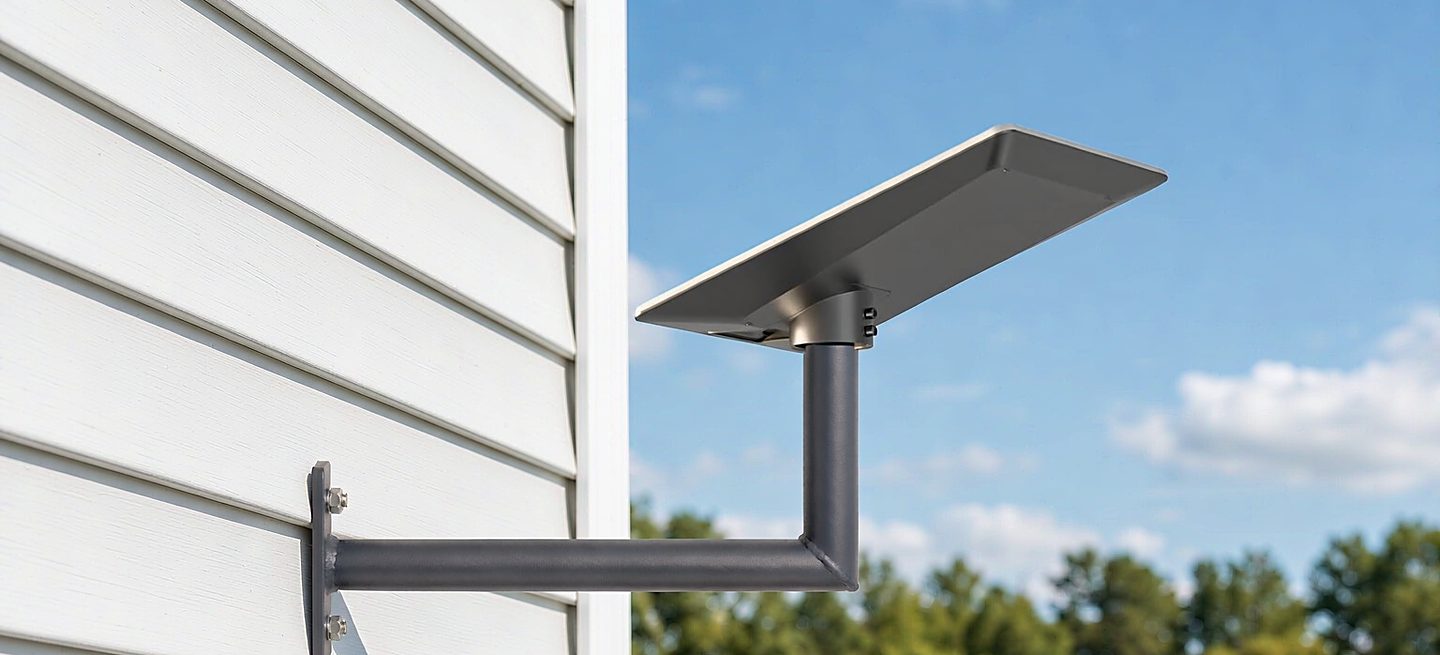
The short version: most home Starlink installs need no building permit. A dish under a metre across, fixed to a wall or roof the way a satellite TV dish has always been fixed, sits inside the exemptions most building codes carry for small antennas. If that were the whole story this page would be one sentence.
It isn't, because the thing that actually stops installs is rarely the building department. It's the HOA architectural review, the landlord clause in a lease, or a neighbour who reads the community rules more carefully than you do. This page separates the three questions people mash together: does this need a permit, will the HOA allow it, and who else has a say. Rules vary by jurisdiction and by community — treat this as the framework for the conversation you need to have locally, not as legal advice.
Why a dish is not a shed
Building codes treat small antennas differently from structures, for a reason that predates Starlink by decades. Satellite TV dishes made the exemption necessary: a 60 cm dish on millions of roofs, each one requiring an individual permit, would have been absurd to administer. So codes generally exempt small antennas and their supporting mounts from permit requirements, provided they stay within size limits and don't turn into something else.
Starlink's standard dish is about 56 cm across — comfortably under the one-metre line that most exemptions use. What the exemption covers is the dish and a reasonable mount. What it does not cover is the moment your install stops being "an antenna" and becomes "a structure": a mast tall enough to need a foundation, a tower, anything engineered rather than assembled. The size of the dish is not the variable that moves you out of the exemption. The height, the permanence and the foundation are.
Permit reality by install type
The same dish on four different mounts lands in four different regulatory worlds. This table is the honest general picture — your municipality's building department is the authority for your address.
| Install | Building permit? | What usually decides it |
|---|---|---|
| Tripod on the ground, taken down when you move | Almost never | No penetration, no foundation, no permanence — it reads as equipment, not construction |
| Ground mount with ballast, left in place | Rarely | Height and whether it reads as an accessory structure; ballast-only bases usually don't |
| Wall bracket on siding or studs | Rarely | Small penetrations into an existing wall are maintenance-class work in most codes |
| Roof bracket, permanent | Sometimes | Roof penetrations and sealing are the part inspectors care about; a handful of jurisdictions require notification |
| Mast or pole raising the dish high | Most likely | Height limits and foundation requirements come from zoning, not the antenna exemption |
The pattern: the closer your install sits to "a bracket and a dish," the more likely no permit is involved. The closer it sits to "a small tower," the more likely one is. A tripod in the yard at dish height and a 6 m mast on a concrete pier are not the same regulatory event, even though the electronics on top are identical.
Once the permission question is settled — or answered "ground only" — the next question is which mount. The four mount types is the place to start, and the roof install guide covers the bracket-and-seal job in detail.
The three questions that decide it
Before you call anyone, answer these three. In most cases they resolve the permit question on their own.
1. Is the dish under one metre? Starlink's standard and mini dishes are. Oversized or stacked arrays are where exemptions stop applying — not relevant to a single-dish home install.
2. Is it permanently fixed to a structure? A bracket screwed into studs or a roof rafter is permanent and that's normal — but permanence is what pulls a permit reviewer's attention, so it changes which questions get asked next.
3. Does it exceed local height or setback rules? This is the question people skip, and it's the one that most often flips the answer. Many municipalities limit accessory structures and masts in side and rear yards, and a mast is measured as a structure, not as equipment.
If the answers are "under a metre, a bracket, within limits" — you are very likely in exemption territory. If any answer pushes the other way, a five-minute call to the building department settles it.
What an HOA can and cannot do
In the US, the FCC's OTARD rule (Over-the-Air Reception Devices) is the relevant frame, and it's worth understanding precisely, because it's widely misquoted in both directions. The rule protects antennas up to one metre in diameter — Starlink's dish qualifies — and it prohibits HOAs from unreasonably delaying or refusing installation. A blanket "no antennas" rule is not enforceable against a compliant dish.
What OTARD does not do is guarantee you your preferred location. The HOA can still regulate, within reason: where the dish goes on the property, how it's mounted, and what it looks like — paint colour, profile, screening from the street, keeping it on the least visible facade. It can ask for a submission before work starts. What it cannot do is impose conditions so restrictive that they materially degrade signal reception — that's the line the rule draws, and it's the line to quote if a conversation goes sideways.
Practically, most HOA approvals are won or lost before anyone quotes a rule. Boards respond well to a one-page submission: a photo of the actual product, its dimensions, a marked-up photo of where it will go, the mounting method, and a line on colour. A bracket install on a side wall, painted to match, with the cable routed neatly, is a very easy yes. The installs that get refused are the ones that look improvised — and they're usually refused for the cable and the bracket, not the dish.
Outside the US, the legal frame differs but the shape of the problem rhymes: community rules and landlord rights tend to matter more than building codes for a dish this size.
Renters: the clause matters more than the permit
If you rent, the permit conversation is almost irrelevant. The lease governs. A landlord can permit or refuse a wall install as a lease matter, and most will say yes to something small and reversible if asked properly — and no if they find a bracket on their siding that nobody mentioned. The whole calculus is different from ownership: you're negotiating a modification to someone else's asset, and the currency is reversibility. Our renter's guide covers which mounts leave nothing behind, and why a freestanding tripod ends most landlord conversations before they start.
What skipping the ask actually costs
Let's be honest about the risk, in both directions. Most unpermitted, unapproved installs are never noticed and never matter — the exemption is real and HOA enforcement is mostly complaint-driven. But the downside is asymmetric in a way worth pricing before you decide:
- An HOA compliance letter usually comes with a cure period — fix it, move it, or submit retroactively — but the fix is at your cost, and doing the job twice costs more than asking once.
- A lease violation can reach the security deposit, and a bracket left behind at move-out is exactly the kind of thing deductions are made of.
- Insurance is the quiet one. If wind takes the dish through a window, the adjuster may ask how it was mounted and whether the installation complied with the lease and community rules. Photographs of a proper bracket into studs, and the manufacturer's instructions, are worth keeping.
- Resale disclosure. An unapproved modification that becomes the buyer's problem is a negotiation you don't want to be having later.
None of this is a reason to panic. It's a reason to spend ten minutes asking, because the cost of asking is ten minutes and the cost of not asking is occasionally the whole install.
The five-minute check, before the ladder comes out
This is the whole compliance process for a typical home install, and it fits in a coffee break:
- Search your city or county building department site for "antenna" or "satellite." You're looking for the exemption language — most publish it, and most exempt small antennas outright.
- Find your HOA's architectural guidelines (CC&Rs, design guide, or the portal where submissions go). Read the antenna section if it exists; read the "exterior modification" section if it doesn't.
- If you rent, read the alterations clause in the lease — the paragraph about fixtures and modifications is the one that applies.
- Check your insurance policy's language on outdoor attachments, especially if you're in a wind or hail exposure area.
- Decide the install type against the table above. Ground tripod, wall bracket, or roof — this determines which of the previous four steps even matter.
And if the answer that keeps coming back is "ask the HOA first," the ground is often the cheaper yes. A tripod with no penetration usually sits outside every approval process — the ground and yard guide covers that install.
If the answers are boring — exemption found, no HOA or an easy yes, no lease issue — install with confidence. If anything is ambiguous, one email to the building department or the HOA board resolves it, and that email is cheap insurance.
Our line
We don't file permits, we don't sell "compliance certificates," and we don't produce engineering drawings for architectural review. We sell the hardware, and we'd rather you spend one evening reading your community rules than one weekend arguing with a compliance letter. If your install lands in the boring majority — a bracket, a dish, no mast — the honest answer is that nobody's permission is needed beyond your own HOA or landlord, and the dish itself is not the hard part.
FAQ
Do I need a building permit to mount Starlink on my roof?
Usually no. Small antennas under one metre are exempt in most building codes, and a roof bracket is maintenance-class work. The exceptions come from height and structure: a mast tall enough to need a foundation, or a jurisdiction that classifies roof attachments as notifiable work. A five-minute check of your building department's site settles it for your address.
Can my HOA make me take the dish down?
Not as a blanket rule. Under the FCC's OTARD rule an HOA cannot unreasonably delay or refuse an antenna up to one metre, which covers Starlink. It can still regulate placement, mounting method and appearance, and it can require a submission first. What it cannot do is impose conditions that materially degrade your signal — that's the enforceable line.
What exactly does the OTARD rule protect?
It protects your ability to install and use a receiving antenna up to one metre in diameter, and it bars HOAs and local governments from unreasonably delaying or refusing that installation. It does not give you the best-looking location, the front facade, or a mast taller than zoning allows — those remain legitimate subjects for community rules.
Can my landlord refuse a Starlink install?
Yes — a lease is a property right, and exterior modifications are the landlord's call. Most will agree to a small, reversible install if asked before it happens and almost none will agree to one discovered afterwards. If you want zero lease exposure, a freestanding tripod needs no permission at all.
Do I need a permit for a tripod in the yard?
Almost never. No penetration, no foundation, no permanence — a tripod reads as equipment rather than construction, and it's gone the day you move. If your HOA has rules about anything visible from the street, a tripod is the easiest of all installs to explain.
Does my insurance care how the dish is mounted?
It can. If storm damage leads to a claim, the adjuster may look at how the mount was fixed and whether the installation complied with your lease and community rules. Keep photographs of the bracket, the fixings and the finished install, and keep the manufacturer's instructions — they are the difference between a conversation and a dispute.
I already installed it without asking. What now?
Talk before you're asked. HOA compliance letters almost always carry a cure period, and boards respond very differently to a retroactive submission with photos than to a neighbour's complaint. If the install is genuinely non-compliant, moving a bracket to the least visible facade is usually the entire remedy.
How tall can a mast go before permits get involved?
That's a zoning question, not an antenna question, and the answer varies by municipality — commonly somewhere in the 2 to 5 metre range for accessory structures before height limits and foundation rules engage. Check your zoning ordinance's accessory-structure section, and assume a mast is measured as a structure, not equipment.
Can I paint the mount to match my house if the HOA asks?
Yes - paint the metal bracket, and a colour-matched mount resolves most appearance objections faster than any argument. What you must not paint is the 1.5 inch thread, the dish itself, or any sealing surface where a fastener passes through. Mask those, use a metal-appropriate primer and topcoat, and re-check the fasteners a season later: paint films can make a tightened joint feel looser than it is.
Wall Bracket
Takes the dish's 1.5 inch thread directly and fixes to the wall studs — the install most HOA boards find easiest to approve.