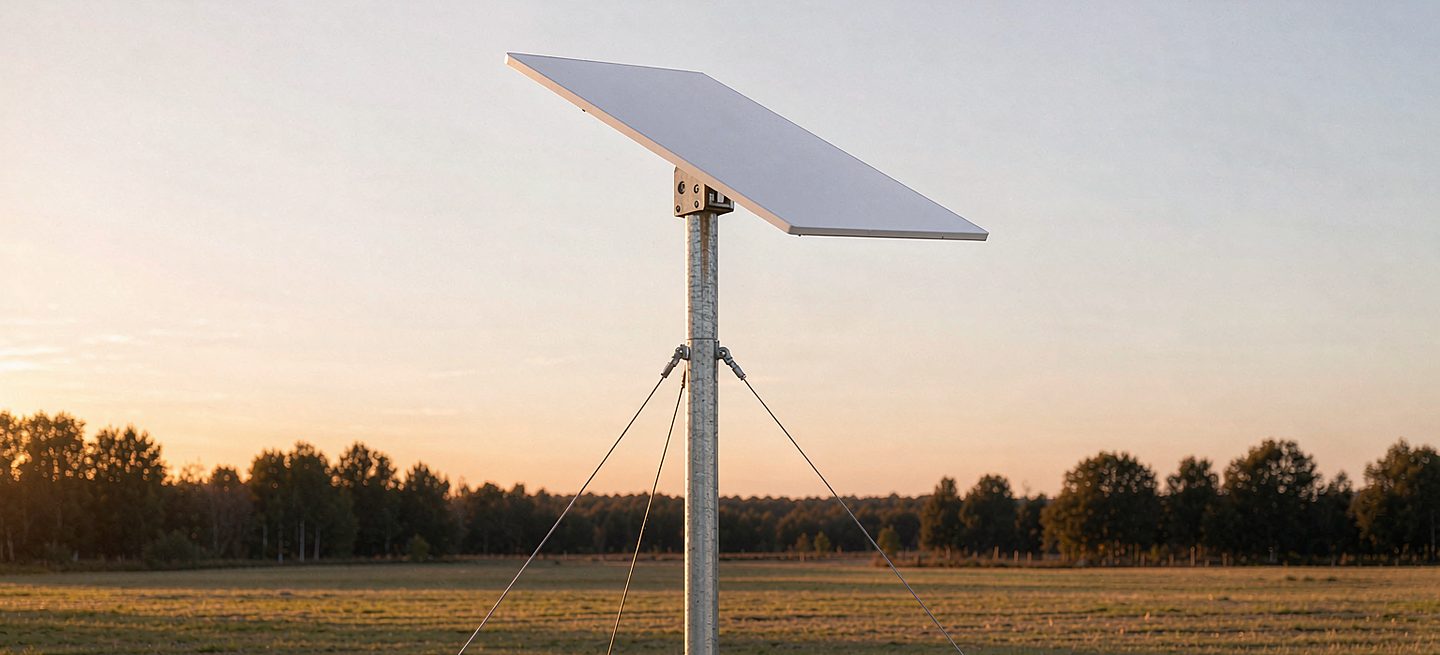
Short version: a pole or mast mount exists to win one argument — height. It is the only mount that can raise the dish above a near obstruction without touching the building, and it is also the mount that takes the most wind load, so the whole job is deciding how tall, how fixed, and whether it needs guying.
Before picking a height, confirm that height is actually the answer: moving the dish sideways often beats raising it, and a clear view at ground level costs nothing.
When a pole is the only thing that works
A pole comes out when the obstruction is close and tall — a roof ridge, a chimney, a single mature tree, a neighbouring wall. In those cases the geometry is unforgiving: the dish needs a clear cone of sky, and the cheapest way to get it is distance above the obstacle rather than a fight with the building.
It is also the answer when there is no building to mount to at all: a yard, a paddock, a field, a rented plot where you cannot fix anything to the structure.
How tall is tall enough
| Obstruction | Rough height needed | Why |
|---|---|---|
| Fence or low hedge | Tripod or short mast (1–1.5 m) | Clears at ground level; a pole is overkill |
| Single-storey roofline | About 3 m | Dish needs line of sight over the eave, not just above the wall |
| Mature tree close by | 4–6 m, or relocate | Canopy keeps growing; height must clear the full crown, not the trunk |
| Two-storey wall next door | 5 m+ or reposition | At low elevation angles the wall blocks a wide arc, not one point |
Treat these as starting points, not measurements. The only reliable method is to run the obstruction check from the proposed height — the app tells you the clear cone, and a metre of extra pole rarely fixes a tree that is genuinely in the way.
Wind is the real design load
A dish on a 5 m mast is a sail on a lever. Wind force rises with the square of speed and the bending moment at the base rises with the length of the lever arm, so doubling the height does far more than double the punishment at the fixing. That is why tall installations stop being about the dish and start being about the mast, the base and the guying.
Three things carry that load: how deep and how wide the base is, how rigid the mast is over its length, and whether anything stops it swaying. A mast that flexes in a gust moves the dish enough to interrupt the link — the dish re-points itself, and while it re-acquires you are offline.
Guying: when it stops being optional
Short masts on a solid base do not need guys. Past roughly 3–4 m, or in an exposed site, they do. Guying works by breaking the mast into shorter spans so it cannot whip, using three or four anchors at around the upper third of the height.
The anchors matter as much as the wires. Ground anchors need to be set into something that will not soften — concrete, a driven stake with a load plate, or an existing structure. A guy line tied to a fence post is a guess, and guesses fail in the first real storm.
Staying clear of cables and the dish's own limits
A pole has to be clear of power lines, and it has to be clear by a margin, not by a hand's width. It also has to keep the dish cable run sane: the standard cable is a fixed length, so a very tall mast can push the router further from the dish than the cable allows. Plan the run before you buy the mast, not after.
And check what the mast is actually carrying. A pole mount uses the dish's 1.5 inch pipe thread, the same as the roof and wall options — so there is no separate official adapter to buy, provided the mast top is threaded for that size.
Our line
We do not sell a mast, and we will say so plainly. What we sell is the part that adapts the dish to it: the roof kit and wall bracket both take the dish's 1.5 inch thread directly, and the same thread is what a threaded mast top expects. If your site needs real height, we would rather you heard that a pole is the right answer than sold you a mount that cannot reach.
What a pole install looks like when it is done right
The mast is plumb, the base is in something solid, the guys are on proper anchors if the height calls for them, the dish clears the obstruction with margin, and the cable enters the building once, sealed. Nothing about it is dramatic — which is the point. A pole that looks settled in a gust is a pole that was designed, not improvised.
FAQ
How tall should a Starlink pole be?
As short as still clears the obstruction. Fence and hedge height usually needs 1-1.5 m; a single-storey ridge about 3 m; a mature tree 4-6 m or a new position. Confirm with the obstruction check from the proposed height.
Do I need guy wires on a Starlink pole?
Past roughly 3-4 m, or on an exposed site, yes. Guys stop the mast whipping in gusts, which otherwise breaks the link while the dish re-points. Anchor them into something solid, not a fence post.
Does a pole mount need the official Starlink adapter?
No. A mast threaded for the dish's 1.5 inch pipe thread takes it directly, the same thread the roof and wall mounts use. There is no separate official adapter required.
Will a taller pole always fix a blocked view?
No. If the obstruction is wide or close, extra height may change very little. Moving the dish sideways is often cheaper and more effective than adding metres of mast.
Can I mount the pole on the ground instead of a building?
Yes, and it is the standard answer where you cannot fix anything to a structure. The base goes into concrete or a proper ground anchor, and the dish still needs a clear cone of sky.
What breaks a pole mount first?
The base and the fixings, not the mast. Wind load at the top becomes a large bending moment at the bottom, so a shallow or soft base fails before the pole bends.
Roof Mount Kit
Uses the dish's 1.5 inch thread directly - no official adapter to buy.