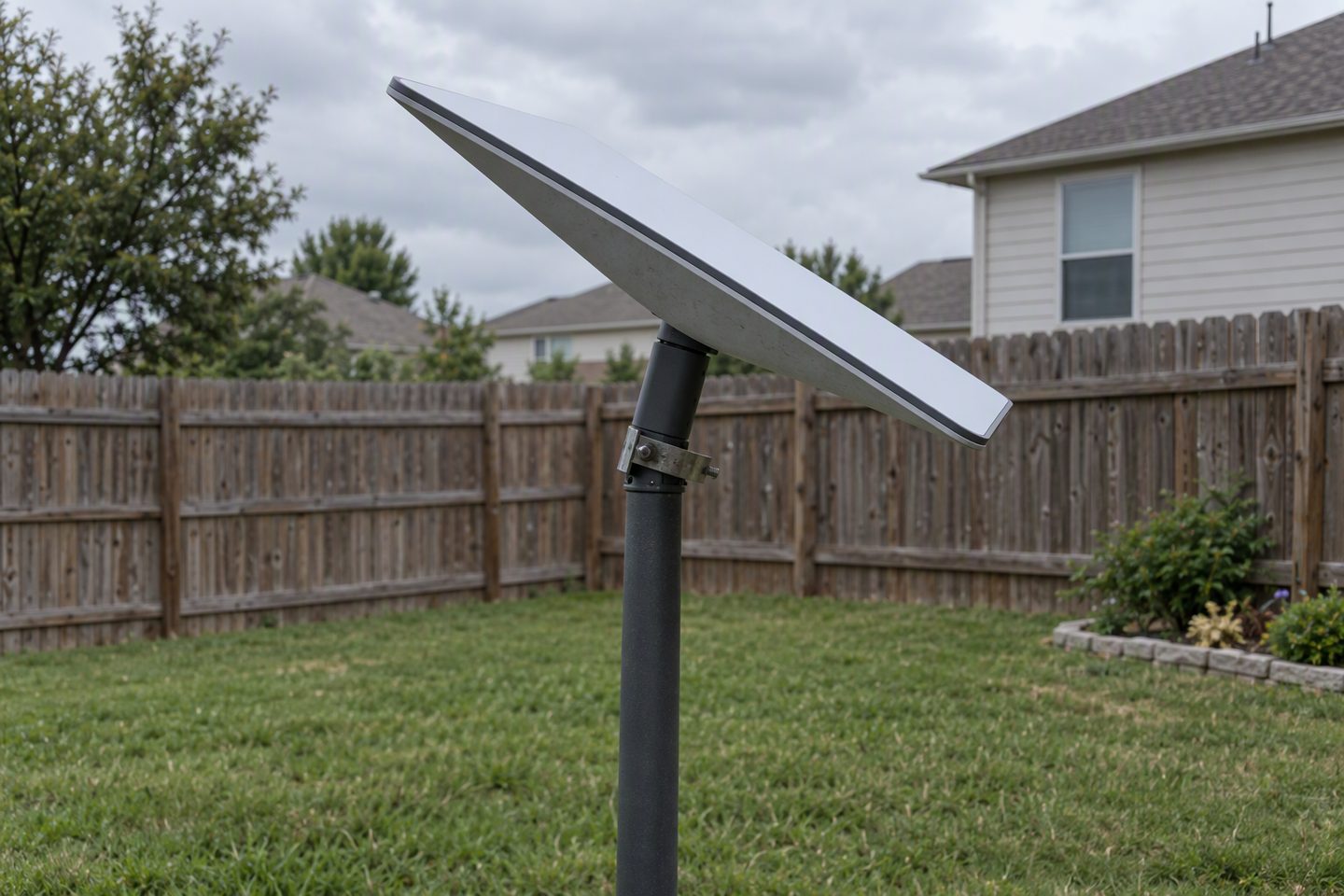
Short version: a Starlink dish that worked last month and drops out today has slipped on the mount, not lost the satellite. Three things actually drift: an under-torqued pole clamp, an undersized pole for the wind load, and a wall fixing that has loosened with the season. Three fixes handle all three: torque the clamp past hand-tight with a lock nut, upsize the pole or guy it, and re-anchor the wall fixing into a stud or a proper masonry sleeve. The 'fix' to skip is shimming the joint, because a shim is a slow leak that ends in a re-install.
The Starlink dish is rigid and the satellite is in geostationary-orbit maths, so 'misaligned' almost always means a joint that has moved, not a dish that has wandered. The good news is that the diagnosis is mechanical: stand on the ground, look at the mount, and the cause is usually visible from 10 m away. This guide walks through the three causes, the three fixes, and the one thing people try that makes the problem worse.
What 'drift' actually looks like
A drifting dish does not fail in a single obvious moment. It fails in three quiet steps that are easy to miss until throughput has dropped 30%.
- The first sign is a latency bump, not an outage. The dish still works, but the round-trip time trends up by 10–20 ms over a few days. The app's obstruction map does not show anything new, and the cable is fine. The mount is the only thing left.
- The second sign is a slow drop in throughput. Speed tests that ran 180 Mbps now run 90 Mbps, and the drop matches the weather. Windy days are worse. The mount is moving under load, not statically, and the dish spends part of every gust looking at the wrong patch of sky.
- The third sign is a visible tilt. A passing glance at the mount shows the dish angled a few degrees off-vertical, or the pole itself leaning. By this point the fix is overdue, but the fix is still the fix.
All three signs are mechanical, not electrical. The dish and the cable are doing exactly what they are told; the mount is the only thing that has changed.
Cause 1: the pole clamp is under-torqued
This is the most common cause by a wide margin. The U-bolts on a pole mount are sized to clamp a 1.5 inch pipe, and most home installs stop tightening the moment the dish stops rotating freely by hand. That torque is exactly the torque that lets a 20 mph gust rotate the dish half a degree. A quarter turn further, plus a lock nut or a drop of medium-strength thread-locker, is the difference between a mount that holds and one that drifts.
The fix: loosen the U-bolts, set the dish to its correct angle using a 4 ft level held against the panel face, then torque each U-bolt a quarter turn past hand-tight. Replace the standard nut with a nylon-insert lock nut, or apply a drop of blue (removable) thread-locker to the threads. Re-check the torque after the first storm, then once a year.
The pole and mast guide walks through the right pole diameter for typical wind zones, and the pipe adapter explainer covers the cases where the dish's pipe thread and the mount's clamp are not the same size — which is when an adapter that is too narrow turns the clamp into a slip joint instead of a fixed one.
Cause 2: the pole is undersized for the wind load
The dish is flat, light, and acts like a sail in any wind above 25 mph. A 1.5 inch schedule 40 pipe is rigid enough for most installs, but a thin-walled tube or a fence-post sleeve will flex under sustained wind, and a flexed mount is a slipped mount over a season. The flex is invisible from the ground but the dish knows.
The fix: upsize the pole to 2 inch OD schedule 40 steel, or guy a 1.5 inch pole with three cables anchored 120° apart at 60% of the pole height. Guying is the cheaper option on a long pole and the only option on a roof where a heavier pole is not practical. The pole and mast guide covers both in detail; the short version is that a 10 ft pole should be guyed at 6 ft with three cables, not left freestanding.
For roof mounts specifically, the equivalent of guying is the proper roof install: fixings into the rafters, not the sheathing, with the mount's base spread across at least two rafters. A roof mount that pulls out in a storm is the same failure mode as a pole that flexes in a storm — the mount is not absorbing the load, the structure is.
Cause 3: the wall fixing has loosened
Wall and eave mounts work fine until they do not, and the failure is almost always in the wall, not the mount. Wood siding swells and shrinks with the season; brick and stucco can take a season to settle around a new fixing; vinyl expands visibly in summer heat. The mount itself is fine, but the screws holding it to the wall have lost a millimetre or two of bite, and a millimetre is enough for the mount to shift under the dish's weight.
The fix: re-anchor the mount into a stud for wood framing, or into a proper masonry sleeve (not a plastic plug) for brick and concrete. If the original install was into sheathing only, the fix is to move the mount to a stud — which is most wall mounts have a multi-hole pattern that lets the same bracket land on a stud a few centimetres over. The wall mount guide walks through finding the stud and choosing the right anchor for each wall type.
The fix that makes the problem worse: shimming the joint
When a dish slips a few degrees, the obvious first attempt is to loosen the clamp, wedge a shim between the pole and the mount, and re-tighten. This works for a week. The shim compresses under the dish's weight and the joint slips again, except now the shim is the only thing keeping the dish pointed where it is, and the shim is a slow leak that ends in a re-install. A mount that needs a shim to hold an angle is a mount that is the wrong size for the pole, not a mount that needs help.
The right answer to a slipping joint is to address the joint, not to wedge it. Either the clamp is the right size and the torque is the problem (fix: re-torque with a lock nut), or the clamp is the wrong size (fix: a proper pipe adapter that matches both diameters), or the pole itself is flexing (fix: upsize or guy). Shims are not on this list for the same reason band-aids are not on a first-aid kit for chest wounds.
A 10-minute diagnostic that catches all three
Before any fix, run through this in order. It takes 10 minutes, costs nothing, and tells you which of the three causes is yours.
- Stand back 10 m and look at the dish. Is the panel face flat and the pole vertical, or is one of them visibly off? A leaning pole is cause 2. A vertical pole with a tilted dish is cause 1.
- Push the dish sideways at the edge with one hand. If it rotates at all, the clamp is under-torqued (cause 1). If it does not move but the pole flexes, the pole is undersized (cause 2).
- Push the mount itself sideways at the wall plate. If the whole bracket moves, the wall fixing has loosened (cause 3). The mount itself should not move when you push it.
- Check the app's obstruction map. A new obstruction that was not there last month is not a mount problem and not covered by this guide — it is a tree problem and the fix is the dish height maths.
Most installs land on cause 1, and the fix is 10 minutes plus a $5 lock nut. Cause 2 is the next most common, and the fix is an hour with a longer pole or a guy kit. Cause 3 is the rarest in the first year and the most common in year three.
Our line
The mount is the part that holds for twenty years if it is right and for a season if it is wrong, and a drifting dish is the symptom of a mount that was right when it left the factory and wrong by the time it left the ladder. Our pole and wall mounts ship with lock nuts and a torque reference, the tools checklist covers the socket sizes, and the best mount for each situation roundup pairs each surface with the mount type that holds its angle through a decade of wind. A dish that points where it is pointed is a mount doing its job; a dish that drifts is a mount that has not been asked to.
FAQ
Why does my Starlink dish keep moving out of alignment?
Almost always because the mount's clamp is not holding a fixed torque, the pole is undersized for the wind load, or the wall fixings have loosened with the season. The dish itself is rigid; the surface it is fixed to, or the joint it sits in, is what moves.
How tight should the pole-mount U-bolts be?
Tight enough that the dish holds its angle under hand pressure, but not so tight that the bolt bottoms out and you have a choice between 'still slipping' and 'crushed pipe'. The right feel is a quarter turn past the point where the dish stops rotating freely. Use locking hardware and re-check the torque after the first storm.
Can wind actually move a Starlink dish?
Yes - a dish on a 1.5 inch mast acts like a sail in sustained wind above 25 mph, and a loose or undersized mount will let it slip a degree or two per storm. Over a season, that adds up to a noticeable drop in throughput and an alert in the app.
Should I re-align the dish myself or call a pro?
Re-aligning a dish on the ground or at single-storey eave height is a 10-minute job with a level and a socket set. Re-aligning a dish on a two-storey roof is not. The first fix is yours; the second is a paid one, and the bill is the same as a fresh install because the work is the same.
What is the single most common cause of a slipping dish?
An under-torqued U-bolt clamp. Most home installs stop tightening the moment the dish stops rotating freely, which is exactly the torque that lets a 20 mph gust rotate the dish half a degree. A quarter turn further, plus a lock nut or thread-locker, is the difference between a mount that holds and one that drifts.
Pole & Mast Mount
A 2 inch OD schedule 40 mount with proper U-bolts and lock nuts — the joint that holds its angle through a decade of wind, not a season.