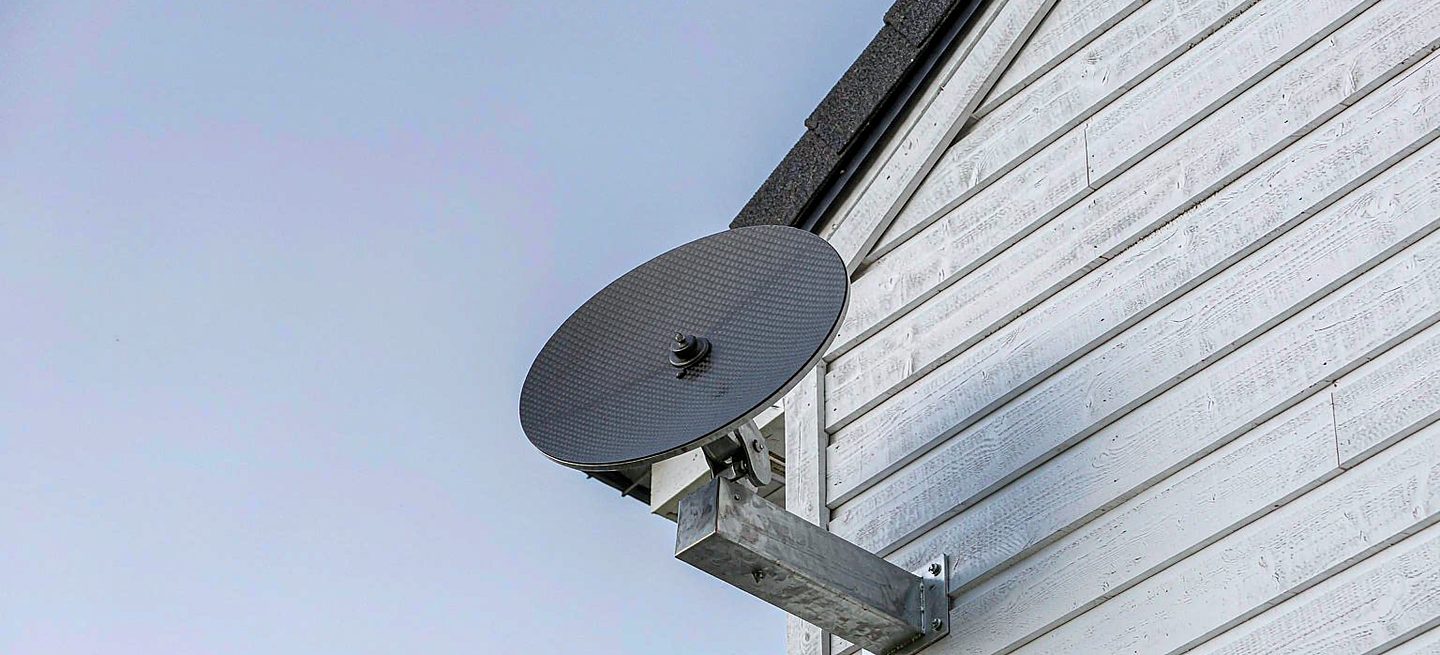
Short version: a wall mount is the middle option between a roof mount (highest, one hole) and a tripod (no holes, low). It lifts the dish well above head height on a surface that is easy to fix, and it leaves the roof covering alone. It only works if the wall faces a clear patch of sky and will take a bracket.
Choosing between the two no-roof options? Wall versus eave breaks down height and fixing. For a rental, the renters guide covers what leaves nothing behind.
Why wall instead of roof
A roof mount is highest and runs the shortest cable, but it puts one hole in the covering. A wall bracket skips that hole entirely and is easier to reach for aim and snow clearance, while still getting the dish well above the garden and most obstacles.
Why wall instead of tripod
A tripod needs no fixing at all, but it is low and wind-sensitive. A wall bracket is steadier, higher, and not dependent on having clear ground — useful when the only good view is up the side of the building.
Clear-view geometry
The wall has to face a patch of unobstructed sky, and the dish has to clear nearby obstacles by angle, not just by being off the ground. The obstruction maths shows how much height you actually need before you drill.
What the wall must take
The bracket has to fix into something solid — studs, masonry, or a rated anchor. Very thin or brittle surfaces need care, and a long arm on a weak wall is the failure mode to avoid.
Our line
The Wall and Eave Bracket takes the dish's 1.5 inch thread directly — no official adapter — and lets you get a clear view without a hole in the roof.
FAQ
Is a wall mount better than a roof mount?
Roof is highest and shortest-cable; wall leaves the roof alone and is easier to reach. Pick by whether you are willing to put one hole in the covering.
Does a wall mount need the official adapter?
No. A wall bracket built for the 1.5 inch thread takes the dish directly, with no separate adapter to buy.
How high should a wall mount put the dish?
High enough to clear nearby obstructions by angle. Check the obstruction maths for your spot before fixing the bracket.
Can I wall-mount on any surface?
It must take a bracket — masonry and stud walls are fine; very thin or brittle surfaces need a rated anchor and care.
Does a wall mount survive wind?
A short arm on a solid wall is steady. Keep the arm short and the fixing rated, and it holds far better than a tall pole.
Wall & Eave Bracket
Get a clear view without a hole in the roof — on the dish's 1.5 inch thread.