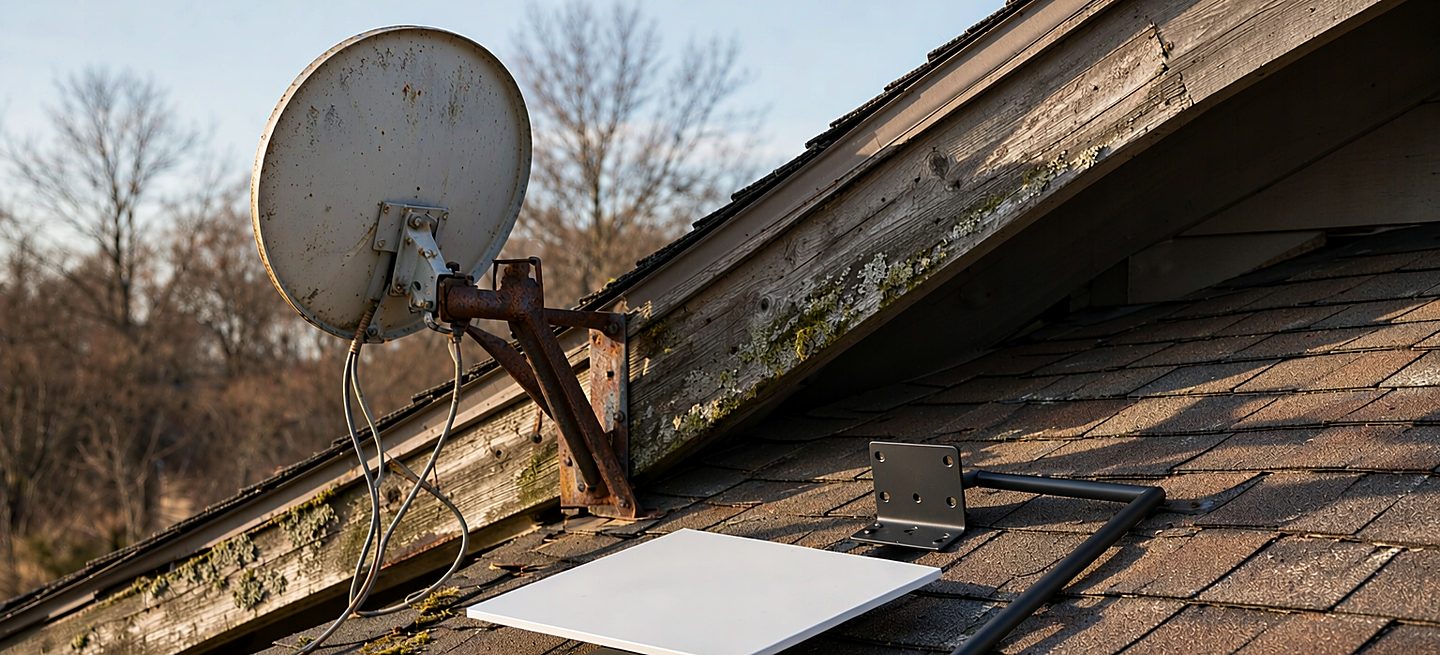
Short version: an old DirecTV or Dish mast can usually carry a Starlink dish, and the physical fit is a measured pipe diameter rather than a brand question. What fails is everything around the pipe: a mast that has spent its corrosion budget, a footplate lagged into trim board instead of structure, and the fact that the old dish was aimed at one satellite in the south while Starlink wants a wide view of a different part of the sky. Measure the mast, put a hand on it, and run the sky check at the old spot before you trust it.
Every spring this question arrives in some form: the old satellite dish has not been used since the streaming box arrived, the mast is still bolted to the eave, and Starlink is being installed at the weekend. Reusing it is the obvious move. It is often the right one, and it is not automatic - so this page is about the three checks that decide it, in the order that saves work.
What is actually bolted to the house
Old satellite hardware comes in three shapes, and each one fails in a different place. Knowing which you have tells you what to inspect.
- A J-mount on the fascia or eave. The most common, and the one people most often mistake for structure. The tube is usually in good shape; the weak point is the four lags holding its footplate to a fascia board, which is trim, not a load path.
- A footplate bolted through the wall. Better, if it reached a stud. Worse than it looks if it only reached sheathing - the plate looks solid and the wall behind it is a panel of oriented strand board.
- A pole set in concrete in the yard. The best case, because the load goes into the ground rather than into the house. The questions move to the pipe diameter, the depth of the footing, and whether the concrete is still gripping the pipe.
None of this is a reason to give up on the old hardware. It is a reason to look at the right part of it before buying anything.
Measure the pipe, not the product listing
The Starlink dish stem is a 1.5 inch pipe thread, and every mount in our range accepts it directly. An old mast is a different animal: it is a plain tube that a collar adapter has to clamp around, so what matters is its outside diameter at the point the clamp will sit - not the diameter written on any listing.
Measure it in one of two ways. Calipers at two heights are the accurate method; a piece of string wrapped around the tube and measured against a ruler, divided by 3.14, is accurate enough to tell 1.75 inches from 2. Do it where the clamp will actually land, not at the shiny top end.
Two traps catch people here. The first is the inner-versus-outer confusion: adapters are sold by the bore they accept as often as by the pipe they fit, and a "46 mm" figure is neither 1.5 nor 2 inches - it lands between them. Read what the adapter accepts as a pipe size and match it to your measurement. The second is ovality: a mast that has taken fifteen years of wind is rarely round any more, and a clamp on an oval tube touches in two places instead of all round. If the tube is visibly out of round or bent, the adapter is not the issue and the mast should be replaced.
If the diameter is right and the tube is sound, the interface question is already answered - the pipe adapter guide covers which mounts need a collar and which do not, so you are not buying one out of habit.
The old spot was chosen for a different job
This is the part almost nobody checks, and it is where a reuse plan most often collapses.
A satellite TV dish points at one satellite parked above the equator. From most of the United States that means a narrow look angle to the south, at somewhere between 30 and 50 degrees of elevation. The installer needed a sliver of southern sky and a short cable run, so the dish often ended up tucked under the eave, hard against the wall, or behind a tree that was smaller at the time.
A Starlink dish is not aiming at one point. Its array steers across a wide field, and the app's obstruction tool asks for a much larger cone of clear sky than the old install ever needed - and in the northern hemisphere a good deal of that working sky is north and overhead, not south. A location that gave flawless satellite TV for fifteen years can score badly for Starlink without anything being wrong with the mast.
So run the obstruction check at the old spot before you spend anything on adapters. If it fails, the mast is not the problem and no amount of new hardware fixes it - height and obstruction covers whether getting the dish higher, or further out from the eave, can rescue the spot.
What the mast was never asked to do
The instinct is that the new dish is heavier, so the old mount must be too weak. Weigh the two and that story usually falls apart: an old oval dish with its LNB is not a featherweight, and its sail area is often larger than a Standard dish's. Mass and wind area are rarely the deciding factor.
Three other things are:
- Corrosion. Thin-wall tube rusts from the inside, where water sits. A mast that looks fine outside can be papery at the base flange - tap it and listen for a dull, soft note rather than a ring.
- The fixing, not the tube. Four lags into a fascia board is a joint nobody has inspected since the day it was installed, and fascia is the first thing that rots behind a gutter.
- Duty cycle. A satellite dish is aimed once and left alone. A Starlink dish is adjusted, nudged and re-checked, and it holds an angle in wind rather than sitting wherever gravity left it. The joint gets worked in a way the old one never was.
That is why the honest test is a hand on the mast, not a spec sheet: grab it and push. A mast that moves at the footplate is telling you the fixing is done, whatever the pipe diameter says. A reused mast also inherits an electrical question along with its holes - fifteen years of galvanising gone means a worse conductor, and the bond has to land on bare metal - which is the grounding page's subject.
Three ways to attach, and when to walk away
Once the diameter is measured, the mast has been pushed, and the sky check has passed, most cases land in one of these rows.
| What you find | What it takes | Verdict |
|---|---|---|
| Round, sound mast; diameter matches a collar adapter; fixings into structure; sky check passes | Collar adapter, or the dish straight on if the thread matches | Reuse it - the cheapest good install there is |
| Sound mast, but the footplate is lagged into fascia or sheathing | Re-fix the footplate into rafters or studs, or move to a wall bracket | Reuse the spot, replace the fixing |
| Mast rusted, oval or bent; footing still solid | New mast in the old footing, if the pipe is a standard size and the concrete still grips | Half-reuse - usually still cheaper than a new location |
| Pole loose in the ground, shallow footing, or frost country with no depth to spare | A new pole with a proper footing (pole and mast guide) | Do not reuse the footing |
| Sky check fails at the old location | Move the install, not the dish | Do not reuse the spot |
| Apartment, rental, or a dish the landlord owns | Written permission before you touch it | Ask first, then reuse |
Notice what is missing from that table: brand. The mount does not care who installed the old one. It cares whether the pipe is round, whether the fixing reaches structure, and whether the dish can see.
Cable, holes and the old coax
The old coax cannot be reused, and this surprises people. It is not Ethernet, it carries no power to a Starlink dish, and the connectors are wrong at both ends. The new cable is a single run with moulded ends, which brings a second problem: the plug is wider than the old hole. A quarter-inch coax hole will not pass it.
So the cable entry gets decided separately from the mount. Either enlarge the old hole to suit the plug and seal it properly, or drill a fresh entry and seal the old one - and seal both on the same day, because an open hole in a wall is a leak on a schedule. That rule, and what to use, is in the removal and moving guide, which is also the page to read if the old dish has to come off in one piece.
Taking the old dish off
Unplug the satellite receiver before you unscrew anything - the LNB at the dish is powered down the coax, and it is the only live part of the assembly. Then the dish itself comes off with the bolts at the mount head, and what is left is aluminium scrap with a resale value close to zero.
The bolts holding the footplate are the ones to watch. They are usually the original lags, they may be seized, and the fascia around them may be soft. If a lag spins rather than backing out, the wood behind it has failed - which is the answer to the whole page, delivered by the hardware itself.
When the honest answer is no
There are cases where the old hardware should be left alone and the dish put somewhere else. A mast rusted through at the base, a footplate in rotten fascia, a pole that rocks in its footing, a spot that fails the sky check, or a dish that belongs to a landlord. In each case the install moves rather than the adapter gets bigger - and moving it is usually cheaper than the repair that follows a failure.
One more: height. If reaching the old mount means a ladder on a wet roof, the saving is not worth it. That judgement is the same one in the removal guide, and it applies here on the way up as much as on the way down.
The order that avoids buying twice
- Measure the outside diameter at the clamp point, at two heights.
- Push and tap the mast, and look at what the footplate is fixed into.
- Run the sky check at the old location - this is the step that decides the job.
- Pick the row in the table, then buy only what that row needs.
- Mount, seal every hole the same day, and re-check after the first real wind.
Four steps cost nothing but an afternoon. The fifth is where the money goes, and it is much smaller once the first four have answered the question.
FAQ
Can I mount a Starlink dish on my old DirecTV or Dish mast?
Usually yes, if three things hold: the pipe is round and sound, its outside diameter matches the dish or a collar adapter you can buy, and the old location passes the sky check. Old masts are plain tubes rather than 1.5 inch pipe thread, so most installs need a collar adapter clamped around the tube. The brand on the old dish is irrelevant - the pipe and the fixing are what matter.
How do I measure the old mast?
Measure the outside diameter where the clamp will sit, not at the top end. Calipers are best; wrapping a string around the tube, measuring the length and dividing by 3.14 will tell 1.75 inches from 2 well enough. Measure at two heights, because old masts taper, bend and go oval, and a clamp on an oval tube only touches in two places.
Will the old dish location get a clear Starlink view?
Not necessarily, and this is the check people skip. A satellite TV dish needs one narrow look angle to the south; Starlink needs a wide cone of sky, much of it north and overhead in the northern hemisphere. An eave tucked behind a tree that has grown for fifteen years can be perfect for TV and marginal for Starlink. Run the app's obstruction check at the old spot before buying anything.
Is the old mast strong enough for the heavier dish?
The weight comparison usually goes the other way: an old oval dish with its LNB is not light, and its sail area is often larger than a Standard dish. What has changed is age, not load. Thin-wall tube rusts from the inside, four lags into a fascia board are fifteen years older than they were, and a Starlink dish gets adjusted where the old one was simply left alone. Push the mast: movement at the footplate condemns the fixing.
Can I reuse the old coax cable and the hole it comes through?
The cable no, the hole maybe. Old coax is not Ethernet and carries no power to a Starlink dish, so it is scrap. The hole is usually too small for the new cable's moulded plug - a quarter-inch coax hole will not pass it - so you either enlarge it or drill a fresh entry and seal the old one. Seal both the same day, or water has a route into the wall.
Do I have to take the old dish down first?
Yes. Unplug the satellite receiver first, because it powers the LNB down the coax and is the only live part of the assembly. Then the dish unbolts from the mount head and goes for scrap. Keep the mast if you are reusing it, and seal every bolt hole you leave behind on the same day - the footplate holes are the ones people forget.
What if the old pole is set in concrete?
That is the best starting point, because the load never touches the house. Check three things: the pipe's outside diameter and roundness, whether the concrete still grips the pipe (push it and watch the base for movement), and the footing depth - in frost country a shallow footing lifts and the dish drifts off aim every winter. A sound footing with a rusted pipe is a half-reuse: new mast, old hole.
Wall Bracket
For the case where the old mast is fine but the old spot is not - six anchor points, 11 inches of reach, and the 1.5 inch thread taken directly.