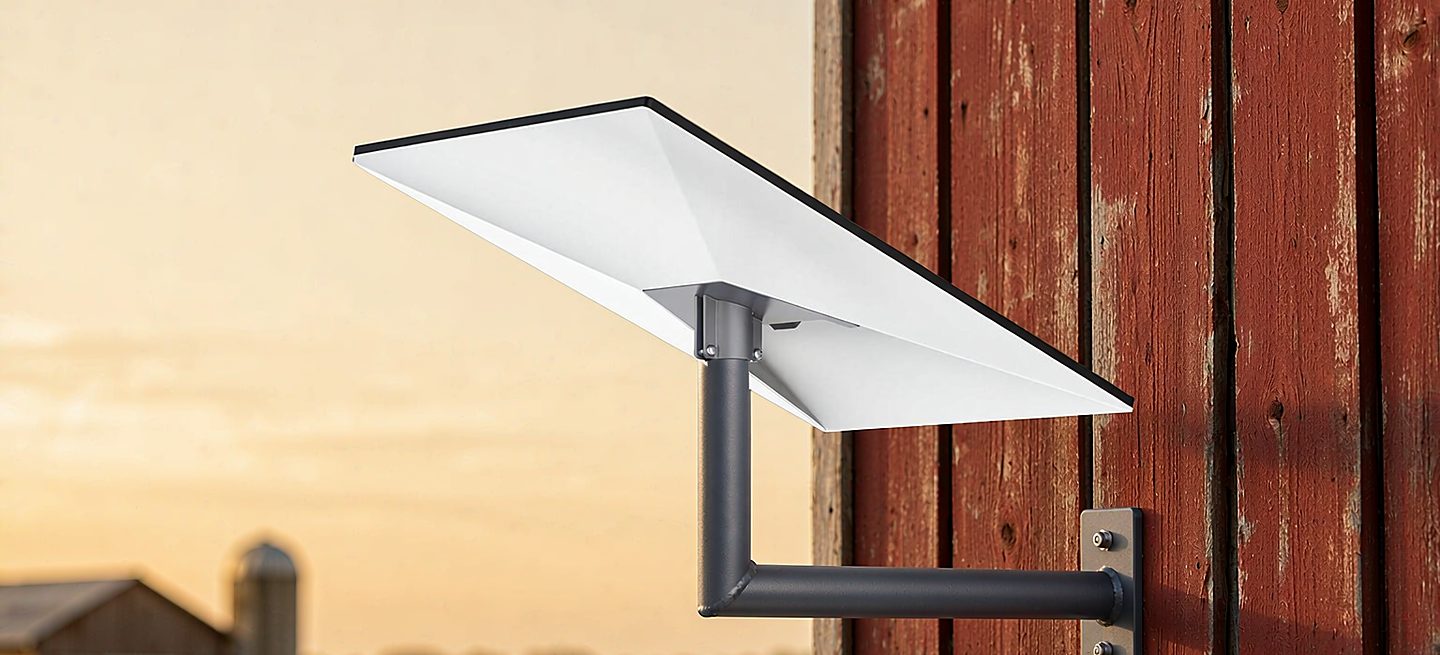
Short version: a cabin install is harder than a house install for three reasons you cannot engineer away — the trees are closer, nobody is coming to fix it, and the power may be off-grid. Everything that follows is about those three. The mount itself is the easy part: it is the same bracket, the same thread, the same bracket-to-dish job. What decides whether the link works in year two is height over the canopy, committing to permanent hardware, and one carefully run cable.
If your cabin is a weekend place rather than a full-time home, the calculus shifts toward no-drilling setups — but for a permanent cabin, permanent mounting is usually the right answer, and this guide is about doing it once.
Why a cabin is the hard home install
Suburban installs fail politely: the dish works most of the time and the exceptions are rare. A cabin in the woods fails the opposite way — when it fails, it fails completely, usually at the worst time. The differences that matter:
Canopy, not one tree. In town, the obstruction is a neighbour's roof or a single oak. At a cabin, the obstruction is the forest itself, and it grows. Every deciduous tree around the clearing is a seasonal obstruction that is bare in April and a wall in July.
Distance from everything. The hardware store is an hour away. If a fastener is the wrong size, that is a round trip on a Friday evening. Bring the full kit — the install tools checklist is the packing list.
No fallback. In town, if Starlink is down you tether to your phone. At the cabin there may be no cell signal at all — the satellite link is not a convenience, it is the connection. Reliability is a safety question more than a comfort one.
Weather loads. Cabins sit in the weather they were built in: snow country, wind exposure, wet summers. A mount that survives a sheltered city wall is not automatically rated for a ridge line.
Height first: the trees decide the mount type
Before choosing a bracket, answer one question: from the cabin, how much of the sky is actually clear? Run the obstruction check on your phone from the candidate spot — the mount you need follows directly from the answer:
| Sky condition from the cabin | What it points to |
|---|---|
| Clear band above the canopy from the roof ridge | Roof kit at the ridge — highest practical point, shortest cable run |
| Clear band above one wall's sightline, blocked from the roof | Wall bracket on the open side — lower than the ridge but clears the local canopy |
| Nothing on the building clears the trees | A mast or pole on open ground — the dish needs to be above the roofline entirely |
| Only a clearing across the yard is open | Freestanding stand in the clearing, long cable run planned around it |
The third row is the cabin-specific answer and the one people miss: when no part of the building is high enough, the mount is not a bracket at all any more — it is a mast. The pole and mast guide covers the structure and the guying; the difference at a cabin is only that the mast usually has to clear tree tops rather than a roofline, and the obstruction check tells you how much extra height that means before you buy pipe.
Do not skip this and "figure it out later." Later is a ladder on a wet day. Height is the one decision that is expensive to change and cheap to plan.
Permanent or temporary: commit to permanent
At a primary home, the temptation is to start with a temporary setup and upgrade later. At a cabin, that logic inverts. Temporary mounts get moved, re-levelled, knocked by a contractor and forgotten — and every move is another obstruction survey. For a permanent cabin, fix the mount once, at the right height, and never touch it again.
That does not mean drilling a historic cabin's original siding to save an afternoon. It means the decision is one-way: pick the spot, pick the bracket, do the sealing properly, and the install is done for the decade. The one legitimate case for a freestanding start is testing — a weekend on a tripod proves the sightline before anyone drills.
Reading the cabin's walls and roof
Cabins are usually timber, and timber frames move. Three specifics separate a cabin install from a house install:
Find the framing. Log cabins are the deceptive case: the logs are not the structure you want, and a bracket bolted to logs transfers every seasonal settlement into the mount. Find studs, a rim joist, or a framed gable end — the same rule as any wall, applied with more care because the wall moves year-round.
Watch the overhang. The eave that keeps rain off the walls also blocks a low slice of sky. A wall bracket under a deep veranda eave can sit in permanent shadow even when the view from the ridge is clear. Check the eave line against the obstruction map, not by eye.
Assume the roof is the roof you have. Older cabins often carry metal or layered shingles over wide-spaced decking. The roof covering guide maps the fastener families — the cabin version of the rule is "engage structure, not covering," because an aged covering will not hold a lag bolt through plywood that has seen twenty winters.
The cable run is the whole job
At a cabin the cable run is longer, more exposed and less forgiving than at a house — and it is where installs quietly fail. Three decisions cover it:
One entry, sealed, with a drip loop. Same rule as everywhere: bore slightly downward toward outside, gland it, drip-loop below. The cabin difference is that the interior side is often the room you are trying to keep dry. The cable management guide has the full method.
Plan the run before you drill. Measure the actual path — along the ridge, down the wall, along the foundation to the entry — not the straight-line distance. Add slack for the drip loop and a service loop at the dish end. Cabin runs eat the stock cable length faster than people expect; if the run approaches the cable's rated length, check what the router placement can absorb.
Above ground beats buried. Stapling the run along the fascia keeps it inspectable, repairable and out of the ground-freeze cycle. If it must cross open ground, conduit and a buried depth that survives your frost line — and a route that does not cross the driveway.
Power at the cabin: plan for the outage
A cabin's power situation decides how the link behaves in the storm that took the grid down — precisely when you most want it up. Two questions:
What runs the dish and router? A weekend cabin on solar or a generator bank needs the numbers: dish draw, router draw, and the runtime you want. The off-grid power guide runs the arithmetic; a small UPS in front of the router is what turns a flicker into a non-event.
Where does the router live? On-grid or off-grid, the router should sit where the cable ends and the power is — not on a shelf in the middle of the room because that is where the old modem was. The router mount guide covers fixing it cleanly.
The seasonal rhythm (the part cabins actually need)
A cabin that stands empty half the year does not get to skip maintenance — it accumulates it. Three checks a year keep the link honest:
Spring: the canopy check. Leaves come back between visits. Re-run the obstruction app each spring; a tree that filled in is the single most common reason a cabin link that worked in November degrades in June. If the view has closed, the answer is a mast or a higher bracket — the dish is fine.
Autumn: the hardware check. While you are winterising, look at the bracket: fasteners tight, no rust weep at the feet, sealant bead intact. Five minutes with a spanner and a tube of exterior sealant now beats the frozen-Saturday diagnosis.
Winter: the snow question. Snow on the dish is an outage for its duration; snow loading on the bracket is a structural question. Keep the dish accessible enough to brush from a ladder, and if the mount is a mast, clear the base before the load matters. The mounts overview compares how the types behave in snow country, and the winter install guide takes each of those loads apart - what snow does to the mount, the slide path, and what it takes to clear the panel.
The take-down option, honestly
If the cabin is unoccupied for long stretches and the site is exposed, there is a case for taking the dish down off-season: it removes wind loading, snow cover and the chance that a storm branch finds the mast while nobody is watching. The cost is a fifteen-minute re-setup each season and a storage place. It is the same judgement call as the tripod case, applied to a fixed install — and for many off-season cabins it is simply the right call.
What not to do
Do not mount low to make the cable shorter. The cable is the cheap part. A run that is thirty metres longer than ideal still works; a dish two metres inside the canopy does not.
Do not trust an eyeball sightline. "Looks clear from here" is how people end up with a dish that works in April and stutters in July. The obstruction app costs nothing and settles it.
Do not bolt to the first solid-looking thing. Logs, trim boards and old fascia look structural and are not. Find the frame, or the log course that has not moved, and bolt into that.
FAQ
What is the best way to mount Starlink on a cabin in the woods?
At the highest point of the building that clears the local canopy, permanently. Start from the obstruction check: if the ridge line clears the trees, a roof kit at the ridge is the answer; if only one wall has a clear sightline, use a wall bracket; if nothing on the building is high enough, put the dish on a mast in the open.
How do I know if my cabin has too many trees for Starlink?
Run the obstruction app from the candidate mount spot, standing where the dish would sit. It shows exactly which directions are blocked and by how much. Bare deciduous branches in winter are misleading - if the check is marginal in April, assume it is blocked in July.
Can I mount Starlink on a log cabin?
Yes, but bolt into structure rather than logs where possible - logs settle and shift seasonally, and that movement transfers into the mount. Find a framed gable, studs or a rim joist; if the only option is a log course, use fasteners that can be re-tightened and re-check them each season.
Do I need a mast instead of a roof mount for a cabin?
If no point on the building clears the tree line, yes. The dish has to be above the canopy, and once that means more than the ridge height, a mast on open ground or a clearing is the honest answer. The mast guide covers height and guying.
How long can the Starlink cable run at a cabin?
Plan the real path - along the ridge, down the wall, along the foundation - not the straight line, and add slack for drip and service loops. Cabin runs are typically longer than house runs, so measure before the hardware store is an hour away. For long runs, the router placement can absorb some length.
Will Starlink work at a cabin during a power outage?
Only if something at the cabin runs it. A small UPS in front of the router keeps a flicker from becoming an outage; for longer outages you need the battery or generator arithmetic from the off-grid power guide - dish and router draws against the runtime you want.
Roof Mount Kit
Permanent cabin installs, done once: takes the dish's 1.5 inch thread directly, built for weather that lasts all winter.